
DOPING
• FIFA has released a statement announcing that Liverpool footballer Mamadou Sakho’s 30-day provisional suspension has been extended to have ‘worldwide effect’. UEFA provisionally suspended Sakho after he returned an adverse analytical finding (AAF) for 30 days. It has been widely reported that the violation was caused by a fat-burning substance.
• Italian rower Niccolò Mornati has tested positive for the prohibited substance of anastrozole, a hormone and metabolic modulator. In a statement released by the Italian National Olympic Committee (CONI), it said that Mornati had been suspended as a ‘precautionary measure’ following an out of competition test on 6 April 2016.
• The Officer of the Commissioner of Baseball has suspended two players for 80 games after they tested positive for prohibited substances. Los Angeles Dodgers pitcher Josh Ravin received an 80-game suspension without pay after testing positive for Growth Hormone Releasing Peptide 2 (GHRP-2). Meanwhile Los Angeles Marlins second baseman Dee Gordon received an 80-game ban after testing positive for exogenous testosterone and clostebol. In a statement Gordon said that he took the substances unknowingly, but that he had ‘made a mistake’ and therefore accepted the consequences.
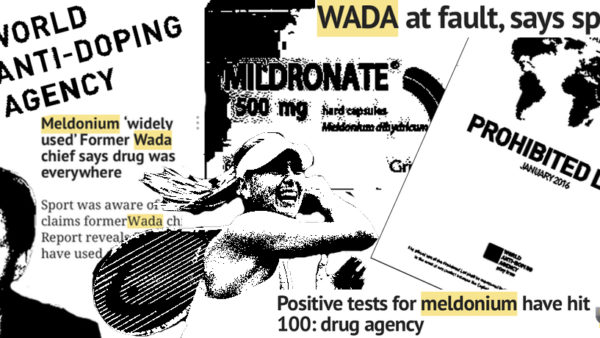
• The International Tennis Federation (ITF) has announced that Belarusian tennis player Sergey Betov will not be suspended from the sport, despite committing an Anti-Doping Rule Violation (ADRV). Betov tested positive for meldonium on 21 January 2016 but the ITF accepted that it was ‘more likely than not’ that the substance found in his sample came from taking meldonium no later than October 2015. Following WADA’s guidance notice on meldonium concentrations, the ITF further reasoned that Betov did not know, nor could have suspected, that meldonium would still have been in his system the date that he was tested. Betov was therefore deemed to have born no fault or negligence.
• A Namibian U20 international rugby player has reportedly failed a doping test following an out of competition test on 5 April 2016. According to news site All Africa, the Namibia Rugby Union (NRU) has decided not to disclose the name of the player. The South China Morning Post has reported that World Rugby has stated that the player’s sample returned ‘an adverse analytical finding for dehydrochlormethyltestosterone and methandienone’, anabolic steroids banned by the World Anti-Doping Agency (WADA).
MATCH-FIXING
• The Secretary of the Board of Control for Cricket in India (BCCI) has reportedly submitted a Private Members’ Bill in India’s parliament recommending a 10 year jail term for sportspeople convicted of match-fixing. According to local news outlets, Anurag Thakur, who is also an Indian MP, said that the move was ‘fair to bring in accountability to be fair to sports lovers’, highlighting that there was no current Indian law for match-fixing. The proposed ‘National Sports Ethics Commission’ bill will also set up a national sports ethics body.
• Local news outlets in South Africa are reporting that Cricket South Africa, the sport’s national governing body, is ‘on the brink’ of charging at least five cricketers for match-fixing. The news follows the admission by former South African international cricket Gulam Bodi that he had fixed matches in the 2015 RAM SLAM T20 Challenge Series, the premier T20 tournament in the country. Bodi was banned for 20 years. The five players facing charges are understood to have ‘had contact with Gulam Bodi’.
GOVERNANCE
• The British Horseracing Authority (BHA) is under scrutiny following the revelation that a number of recent independent Disciplinary Panels, called to hear disciplinary cases in British horseracing, featured solicitor Matthew Lohn. Lohn is a senior partner at the law firm Fieldfisher, which, according to The Guardian, has recently given professional advice to the BHA on non-disciplinary matters. In April trainer Jim Best had an application for stay of penalty approved after the Appeals Panel found Lohn’s position to be a cause of ‘very great concern’. Another trainer, Paul Gilligan, who was penalised for running a horse in an unrecognised race, has reportedly decided to appeal his ban on the same grounds as Best.
• A National Rugby League (NRL) Integrity Unit investigation has ‘made preliminary findings’ that ‘since at least 2013’, the Parramatta Rugby League Club, the Parramatta Eels has exceeded the salary cap and thereby given its team an unfair advantage. The investigation determined that the club had devised a ‘deliberate, co-ordinated and sustained’ operation in evading the salary cap. As a result the club has received ‘one of the most severe punishments ever handed out in Australian rugby league’, which includes being deducted 12 points and fined AUD$1.25 million (€816,000).
• The adjudicatory chamber of FIFA’s independent Ethics Committee has banned Lionel Haven from all football-related activities. Haven is a former Executive Committee member of the Caribbean Football Union (CFU) and was banned for failing to disclose information related to ‘cash payments at an event held by the CFU in May 2011’. The decision was only made public because the Ethics Committee were unable to contact Haven ‘at his last known postal address’.
• Kuwait’s government has reportedly launched legal action ‘against FIFA and other international federations’ for banning it from international sports tournaments. According to the investigative site Inside World Football, a report ‘prepared by the Kuwaiti Minister of Information and Youth Affairs, Sheikh Salman Al-Hamoud’ has been published in Kuwaiti newspaper Al-Qabas. The report allegedly states that Kuwait’s government had filed ‘seven cases’ against the International Olympic Committee (IOC) and FIFA at the Court of Arbitration for Sport (CAS). FIFA suspended the Kuwait Football Association (KFA) last year after a new sports law was implemented which was considered to impede the KFA’s ability to carry out its ‘activities and obligations independently’.
• The Brazilian parliamentary inquiry into corruption in football has reportedly ‘requested interviews’ with former Brazilian FA (CBF) President José Maria Marin and Brazilian businessman José Hawilla. Both men are unable to leave the USA due to the ongoing US Department of Justice investigation into corruption in global football. The inquiry has reportedly approved for ‘a number of representatives’ to travel to the US in order to conduct the interviews.
• Qatar’s Supreme Committee for Delivery & Legacy (SCDL) has launched an investigation after a 48-year old Indian worker on a stadium construction site died following a heart attack. ‘Al Khor Hospital reported the cause of death as cardiac arrest’, read a statement. ‘All relevant authorities were notified and a full investigation is underway’. A Workers Welfare Progress Report, covering April to December 2015, confirms that two other Indian workers have recently died due to heart issues. In October 2015 a 52-year old painter at the Khalifa International Stadium site died after suffering a heart attack and in January 2016, a 55-year old heavy goods driver died after suffering a heart attack. ‘Investigations into both incidents confirmed that work duties were not a contributory factor’, read the report.
• The international basketball federation (FIBA) is to meet on 14 May to discuss its next steps, after it threatened to expel any national federations with links to the Euroleague competition, ahead of the Rio 2016 Olympics. Of the 14 responses received, FIBA said that it would ask ‘a number of national federations for clarification’. A 21 March FIBA Europe statement read: ‘With the exception of the 16 Euroleague teams, any National Federation that supports ECA’s illegal tying practices by allowing their leagues or clubs to conclude and/or implement agreements with ECA, or any other entity directly or indirectly linked to it, will automatically lose the right to participate in Senior men national team competitions organised by FIBA Europe. The withdrawal of the right to participate in European International Competitions may extend also to other competitions.’