New Governance Code will ensure highest levels of transparency in British sport

Charter for Sports Governance in the UK published

UK sports bodies and organisations that want to receive public funding will have to adhere to a new Code of Governance to help ensure that the highest levels of transparency, ethical standards and leadership are present across sport in this country.

Charter for Sports Governance in the United Kingdom has been published today that outlines some of the main themes that will feature in the code that will be finalised later this year and come into effect in 2017.

While governance in the publicly funded sport sector in the UK is already at a good standard the Code, being drawn up by UK Sport and Sport England, will build on this further. It will be ambitious and set high expectations for any sports organisation that wants to be in receipt of public funding. This will not only protect that investment but also help good organisations become exceptional.

Minister for Sport David Evennett said:

“Sport has a unique power that improves the lives of millions of people in the UK so it is only right that we do all we can to ensure that sport bodies uphold the highest levels of governance and integrity.”

“Governance in publicly funded sport is at a good standard in this country but we cannot be complacent. The new code will mean a more consistent approach so that organisations know exactly what is expected. Sport bodies have to be accountable for the public money they receive and we are absolutely clear that those that do not adhere to the new code will not receive public funds in the future.”

Sport England chief executive Jennie Price said:

“Public trust is something that needs to be earned, so it’s essential that organisations receiving public funding meet the highest standards of integrity and governance. We already set the bar high in the UK, but the charter being published today and the detailed code that will follow it will challenge sports bodies in the UK to become some of the best governed in the world.”

UK Sport CEO Liz Nicholl said:

“The Charter published today shows our commitment to developing a new Governance Code for sport in the UK to promote continuous improvement in the sport sector.”

“We expect and encourage all the sports we work with and invest into to be responsible and accountable while adhering to the highest ethical and professional standards in delivering Olympic and Paralympic success.The Code will build on the many existing examples of sound governance and exceptional leadership, while continuing to drive excellence and protect the integrity of British sport.”

The main elements in the Charter that will form the basis of the code are:

Transparency

Organisations must be clear to both stakeholders and the public about why they exist, what their strategy is and how they are structured with annual reports and accounts published with transparency around all public funding.

Integrity

Organisations must demonstrate that they have adequate measures in place to protect against sport manipulation. Those holding senior positions of office will sign a declaration stating that they are of ‘good character,’ defined through the use of objective criteria, and that they have the skills and experience for their role.

Financial probity

Organisations must be fully accountable for their use of public funding, accounting for every penny and demonstrating how it has been used to achieve the purpose for which it was given.

Leadership and decision-making

Organisations must have fit-for-purpose boards and the code will, in some cases, look to build on existing requirements such as term limits and the size of boards. The code will look to ensure best practice in decision-making.

Membership

Organisations with membership bases will have to ensure that healthy democracy exists. Further consultation will be undertaken to identify best practice in how governing bodies should engage with their members.

Independence of thought

Organisations’ decision-making bodies must include a sufficient number of people who are free from a close connection to the organisation and who provide constructive challenge.

There will also be a consultation on increasing independence on sports boards. This will include looking at whether the existing requirement of a minimum of 25% of independent board members should be increased as well as looking at a possible new requirement for independent chairs.

Diversity

Organisations must have diversity in their leadership, decision making and throughout their workforce. The target for women on boards (or men where they are the underrepresented group) will increase from a minimum of 25% to 30%.

There will also be a consultation on the introduction of other specific targets (including for BAME and disability representation on boards) and guaranteed interview schemes for under-represented groups.

Culture

The code will also look to ensure that there is a good organisational culture in sports organisations to help them achieve optimum performance.

Sport England and UK Sport will work together to support sport organisations that want to be eligible for public funding to achieve the requirements of the Governance Code for Sport in the UK.


• This press release was originally published by the UK Department for Culture, Media & Sport on 12 May 2016. To access the original, please click here.

Over 3,600 athletes test positive for meldonium in year before ban

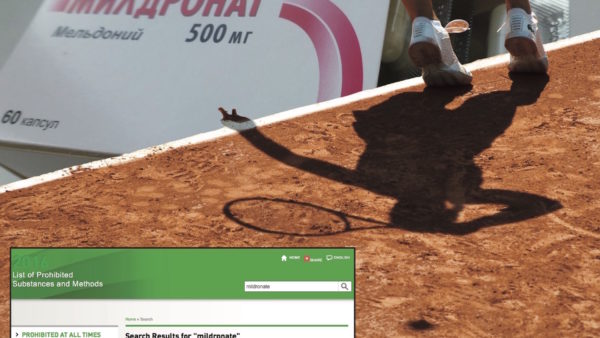
A total of 3,625 athletes tested positive for meldonium in 2015, the year before its ban came into effect when the 2016 Prohibited List was published on 1 January. Figures published by the World Anti-Doping Agency (WADA) show that 6.2% of the 58,760 samples collected both in and out of competition tested positive for meldonium concentrations greater than 20ng/mL.

However, WADA’s findings represent a concentration of meldonium at extremely low levels. In its Guidance Notice on meldonium, WADA recommends that anti-doping organisations should only process an adverse analytical finding (AAF) when the concentration of meldonium is between 1μg/mL and 15μg/mL and the doping control was undertaken on or after 1 March 2016. The 6.2% of samples represent positive tests for meldonium at a concentration of 0.02μg/mL. If a test was taken between 1 January and 1 March, it only recommends proceeding in processing an AAF if the concentration of meldonium is above 15μg/mL, or 15,000 ng/mL.

As our table shows, canoe/kayak returned the highest percentage of positive tests for meldonium in 2015. The highest number of meldonium positives (549) was returned by athletics, however this represented just 7.7% of the 7,065 athletes tested. The diversity of the sports featuring in the top ten could lend support to claims that the drug is used as an insurance policy against heart attacks and is not performance-enhancing.

In April, the World Anti-Doping Agency (WADA) said that there have been 172 meldonium positives since the 2016 Prohibited List was introduced on 1 January. Our table (below) shows how case management is progressing for those athletes who have tested positive.

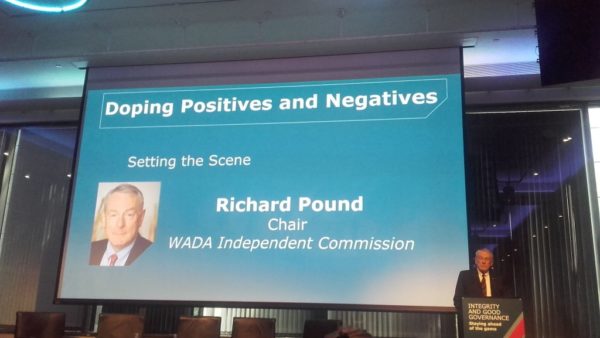
At the Sports Resolutions conference in London last week, WADA’s founding President Dick Pound said that he didn’t think WADA had made a mistake about adding meldonium to the Prohibited List. “In the sense of identifying it as a drug to go on the List, the scientific process we go through and the consultation is huge, on an annual basis”, he said. “There was a very clear consensus that it should be on the List. What hadn’t been done, apparently, is sufficient study on the excretion times – how long does this stuff last.”

The only known scientific study on excretion times for meldonium was published on 4 May this year. The study, which was performed on ‘two healthy male volunteers’ (not elite athletes), found that meldonium exited the body in two phases – a rapid phase followed by a slower elimination phase. It could provide some support for athletes who have tested positive for meldonium, but claim to have stopped taking it before the 2016 Prohibited List came into effect on 1 January.

‘According to literature data, the estimated half-life (t1/2) of meldonium during the initial rapid elimination phase is 5–15 h’, it reads. ‘The results of this pilot study suggest the existence of a subsequent second and substantially slower elimination phase, attributed to a proposed incorporation of meldonium into erythrocytes. The administration of a single oral dose of meldonium was detected in human urine for up to 49 days using established doping control analytical approaches and in DBS for at least 16 days. In consideration of the multi-dose administration data and reported accumulation effects regarding meldonium and the aforementioned results that suggest the incorporation of the drug into erythrocytes allowing for sustained liberation during eryptosis, detection windows after long-term administration of high but yet therapeutic amounts of meldonium span over several weeks and might even extend to months.’

• The Sports Integrity Initiative was alerted to the 2015 WADA study on meldonium by Dutch public broadcaster NOS. You can view its article, which was published today, by clicking here.

Perera acquittal a worry for WADA and athletes alike

Sri Lankan international cricketer Kusal Perera has had his provisional suspension lifted with immediate effect after the International Cricket Council (ICC) withdrew all disciplinary charges yesterday. The turnaround comes after the WADA-accredited laboratory in Qatar withdrew its original Adverse Analytical Finding after further investigations found that the cause of the finding may have been naturally generated. ‘We wish to make it clear that there is no evidence that Mr Perera has ever used performance-enhancing substances,’ the ICC said in a statement.


Perera was provisionally suspended by the ICC on 9 December last year after a sample provided by the wicketkeeper-batsman on 12 October 2015, as part of an out-of-competition drug test, was found to contain a Prohibited Substance under the World Anti-Doping Agency’s (WADA) Prohibited List.


Once Perera’s B sample also tested positive, confirming the presence of the same substance in those samples, Sri Lankan Sports Minister Dayasiri Jayasekera told local media that they would support him with legal representation. At the time, the identity of the Prohibited Substance was not released, which is usual practice following the public disclosure of a violation of the ICC’s WADA-compliant Anti-Doping Code. In yesterday’s statement the ICC confirmed that the substance originally detected was 19-Norandrostenedione, an anabolic steroid prohibited under WADA’s Prohibited List.


In a statement the ICC said that it had been working with Mr Perera’s lawyers since it charged him with an anti-doping rule violation (ADRV) in December in an attempt to identify the source of the banned substance in Perera’s samples.


At the time of Perera’s provisional suspension, he was in New Zealand as part of Sri Lanka’s squad to contest a Test series against the host nation. He was sent home from the squad and interim Sri Lanka coach Jerome Jayaratne told local media that they suspected the source of the Prohibited Substance to be some form of medication taken to treat an insect bite on his foot. Perera continued to maintain his innocence and that the source of the Prohibited Substance remained unknown to him. According to reports he even submitted polygraph and hair tests to prove is innocence.


A long-running and detailed investigation into the potential sources of the 19-Norandrostenedione by Perera’s lawyers, the UK-based firm Morgan Sports Law, earlier this month suggested that the Qatar laboratory might have misidentified impurities in Perera’s samples as the Prohibited Substance, due to ‘the very low concentrations’ found in the samples.


A subsequent independent expert review of the findings, commissioned by the ICC, then found that an adverse analytical finding by the laboratory was ‘not sustainable’ because it could not be ruled out that the 19-Norandrostenedione was produced naturally in the player’s body and/or formed in the samples after the player provided them. The Qatar laboratory immediately withdrew the Adverse Analytical Finding and instead reported an Atypical Finding – a false positive.


Perera’s acquittal will provide troublesome reading for WADA, following the recent suspensions of a number of WADA-accredited laboratories in the last few weeks. Whenever a laboratory does not meet International Standard for Laboratories (ISL) requirements, WADA may suspend the laboratory’s accreditation, which it has done for laboratories in Lisbon, Beijing and Bloemfontein. Last week, WADA’s President Craig Reedie released a statement acknowledging that, in light of these suspensions, some athletes ‘might question whether they can retain full confidence in anti-doping sample analysis procedures’.


Perera’s acquittal will no doubt compound such concerns.


Another concern publicly voiced by anti-doping experts is that the overturning of Perera’s suspensions would not have been possible without the diligence, and expense of, a specialist legal team. David McArdle, a Senior Lecturer in Law at Stirling University earlier tweeted that ‘the average athlete can’t afford to do what Perera did’ and called for any positive tests to have come from the Qatar laboratory to be independently tested, adding ‘not by WADA’.


WADA is yet to comment on the ICC’s statement. Sri Lanka Cricket (SLC) earlier today held a press conference with Perera, the SLC president Thilanga Sumathipala, Sri Lankan Sports Minister Dayasiri Jayasekera and Perera’s manager.


“Now that we have proved beyond reasonable doubt that our player is innocent, and the ICC has agreed with our scientifically approved case that this is right, he [Kusal] has a claim and we will look at it separately,” Sumathipala told the assembled media.


“The ICC has agreed that the tests done of Kusal is not up to the standard. It came out because of our scientific evidence. The evidence that we have given have taken the ICC to a different level of how they should approach this current situation in the future.”


“You must understand however that we, as part and parcel of the ICC, want to continue our role as an ICC member. If the Minister wants to hold a different position separately, we can discuss this in the future.


“I’m sure Sri Lanka cricket will go forward and discuss things with the ICC with regard certain cost, which I would like to refrain from at the moment because I am confident that we got the hard part right.”


Sri Lanka’s national cricket team are currently in the UK preparing for their first Test against England which begins on 19th May at Headingley. In resonse to Perera’s exoneration, former Sri Lankan captain Kumar Sangakarra questioned whether ‘a simple sorry’ was enough for the ‘trauma’ Perera had gone thru and the cricket he had missed. Sangakarra further added that the best way to support Perera now was to ‘get him back playing in England as soon as possible’.


In a final tweet Sangakarra questioned whether Kusal Perera should even have been provisionally suspended in the first place, tweeting that the ‘process should be innocent until proven guilty and players like Kushal should be allowed to play provisionally’.


The observation is a timely one; in March West Indian international Andre Russell missed three doping tests within a 12-month period, constituting a ‘whereabouts failure’ and thereby an anti-doping rule violation under the WADA Code. However the Jamaican Anti-Doping Commission (JADCO), in its discretion, decided not to impose an optional provisional suspension on Russell, deciding to wait instead for the outcome of a disciplinary hearing. This allowed him to compete in both the recent ICC World T20 and the on-going Indian Premier League (IPL). Perera, on the other hand, due to the nature of his Anti-Doping Rule Violation was given a mandatory provisional suspension and missed the World T20.

ICC withdraws disciplinary proceedings against Kusal Perera

The International Cricket Council (ICC) today announced that it has withdrawn disciplinary charges against Sri Lanka batsman Kusal Perera and lifted the provisional suspension previously imposed on him.

Mr Perera is, therefore, now free to return to domestic and international cricket without restriction and with immediate effect.

The ICC has made the decision after the WADA-accredited laboratory in Qatar today withdrew its original Adverse Analytical Finding following further investigations.

DETAILED ICC STATEMENT IS AS FOLLOWS

In November 2015, the WADA-accredited laboratory in Qatar reported to the ICC that urine samples collected out-of-competition from Sri Lankan international player, Kusal Perera, had tested positive for 19-Norandrostenedione, an anabolic steroid prohibited under WADA’s Prohibited List.

Pursuant to the ICC’s WADA-compliant anti-doping code, the full laboratory documentation packages in respect of each of the findings were reviewed by three members of the ICC’s Independent Review Board (comprising of world leaders in the medical, scientific and legal fields of anti-doping), each of whom independently confirmed that Mr Perera had a case to answer. Accordingly, on 7 December 2015, the ICC charged Mr Perera with an anti-doping rule violation and, in accordance with the mandatory requirements of the code, provisionally suspended Mr Perera until that charge was resolved.

Since that time, the ICC has worked with Mr Perera’s lawyers as they have attempted to identify the source of the 19-Norandrostenedione found in the samples. As part of those efforts, the ICC sought further information from the Qatar laboratory and granted various extensions of time to the player’s legal team to allow it to carry out additional analysis and investigation work. In addition, the Qatar laboratory analysed the B samples provided by Mr Perera in January 2016, and reported that that analysis confirmed the presence of the same substance in those samples.

In a recent letter, Mr Perera’s lawyers provided an update on their investigation into potential sources of the 19-Norandrostenedione found in his samples, but also suggested for the first time that the Qatar laboratory might have misidentified impurities in the samples as 19-Norandrostenedione, given the very low concentrations of that substance found in the samples.

In response, the ICC commissioned an independent expert to review all of the Qatar laboratory’s findings. Whilst the independent expert concluded that the Qatar laboratory had correctly identified 19-Norandrostenedione in the samples, that expert’s view was that an adverse analytical finding by the laboratory was not sustainable, because, for various scientific and technical reasons, it could not be ruled out that the 19-Norandrostenedione was produced naturally in the player’s body and/or formed in the samples after the player provided them. These concerns were immediately presented by the ICC to the Qatar laboratory, which has today confirmed that it has withdrawn the Adverse Analytical Finding and is instead reporting an Atypical Finding. It has advised that no specific further investigation of the player’s two samples is warranted, but has recommended the monitoring of the player’s steroid profile moving forward.

As a result, the ICC has immediately withdrawn the disciplinary proceedings previously brought against Mr Perera, and he is therefore free to train and compete domestically and internationally again without restriction with immediate effect.

ICC Chief Executive David Richardson said: “Cricket is proud of its compliance with the structures and systems required by WADA and takes comfort from the fact that samples are tested in accordance with WADA-approved standards and at WADA-accredited laboratories. However, the ICC is troubled in this case by the fact that the Qatar laboratory has issued an Adverse Analytical Finding that has then had to be withdrawn and replaced with an Atypical Finding.

“Whilst I am confident that this is an isolated incident in respect of tests commissioned by the ICC, we are seeking an urgent explanation from WADA and the laboratory in an attempt to understand what has transpired and what will be done to ensure it does not happen again. We will also immediately review our own internal processes to see whether there might be additional steps over and above those required by WADA that the ICC could put in place in order to give international cricketers further comfort.”

He went on to say: “Had it not been for the diligence of Mr Perera’s legal team and the ICC’s own desire to uncover the explanation for the reported findings, the consequences could well have been different, and that should be of concern to all involved in the fight against doping. We regret what Mr Perera has had to endure, and would like to commend him for the manner in which he has conducted himself throughout this period.

“We wish to make it clear that there is no evidence that Mr Perera has ever used performance-enhancing substances and we wish him well in his future cricketing endeavours.”

• This media release was originally published by the International Cricket Council (ICC) on 11 April 2016. To access the original, please click here.

Sporting bodies to sign anti-corruption pledge at UK summit

Sporting bodies such as FIFA and UEFA, which are attending the UK government’s Anti-Corruption Summit in London tomorrow, will sign a statement pledging to fight corruption in sport, the government’s Anti-Corruption Champion Eric Pickles told The Guardian. The summit will also hear about what progress has been made by the Government Integrity Group for Sport (GIGS), which has been drawing up a mandatory governance code for sport, which is planned to be put out to consultation in September.

“We have set up a group, curiously called the GIGS group – the government integrity group for sport – drawing from across Whitehall and from the key agencies, such as the Gambling Commission and UK Anti-Doping”, said Baroness Neville-Rolfe during a debate in the House of Lords yesterday. “We will be putting the governance code out to consultation…I can confirm that corruption in sport will be on the summit’s agenda this week.”

The mandatory governance code is part of the Sporting Future strategy outlined by the government in December last year and will be mandatory for all sports bodies that want to receive public funding from 2017. It will be based on the Financial Reporting Council’s (FRC) Corporate Governance Code, and will be drawn up by UK Sport, Sport England and other home nation sports councils by September 2016. ‘This Governance Code will build on and strengthen existing commitments, including the requirement for all sports’ boards to have at least 25% female representation by 2017’, reads the strategy.

The summit will also consider whether legislation is needed to tackle corruption in sport, such as the criminalisation of doping – as has occurred in Italy and Germany. “We are looking at the whole area, including the question of criminal sanctions”, said Baroness Neville-Rolfe. Although criminal sanctions are not part of the Sporting Future strategy, a Department for Culture, Media and Sport (DCMS) spokesperson told the Sports Integrity Initiative in December that criminalisation of doping was on the agenda.

Sports Integrity Briefs – 11 May 2016

• The Brazilian Laboratory of Doping Control (LBCD) estimates it will collect over 5,000 samples during the Rio 2016 Olympic Games and 1,200 during the Paralympics. The Brazilian Anti-Doping Control Authority (ABCD) told the Ministry of Sport that it has employed 96 of the 130/140 Doping Control Officers (DCOs) that will be needed by the time the Games open in July. During the 2016 Games, the laboratory will work 24 hours, seven days a week. The Brazilian government has invested R$151.3 million (€38.2 million) in a new building to house the LBCD.

• The Union Cycliste Internationale (UCI) has decided to lift the provisional suspension of Eduard Vorganov (pictured), who returned a positive adverse analytical finding (AAF) for meldonium on 14 January. ‘The case is not yet resolved as the results management is ongoing’, read a UCI statement. ‘At this stage and until the adjudication of the case, the UCI will not comment any further. In April, the World Anti-Doping Agency (WADA) said that there have been 172 meldonium positives since the 2016 Prohibited List was introduced on 1 January. To view a table of those we know about, click here.

• A New Zealand rugby union player has been banned for six years for trafficking steroids. Drug Free Sport New Zealand (DFNZ) announced that New Zealand Rugby had sanctioned Andrew Burne after he pleaded guilty to; use, possession and trafficking anabolic steroids.

• The Football Association of Malaysia (FAM) has reportedly lifted the bans imposed on 84 footballers charged with match-fixing in 1994. According to local newspaper The Star, the Deputy President of FAM, Datuk Seri Affandy Hamzah, said that all players were now ‘free to participate in all football-related activities’. The President of the Malaysian Football Coaches Association (MFCA) has reportedly urged those with lifted bans to return to the game as coaches. Six players serving life bans for match-fixing will reportedly have their bans appealed by FAM to the AFC (Asian Football Confederation) and FIFA. Last month The Sports Integrity Initiative reported the Malaysian Anti-Corruption Commission (MACC) arrested four former footballers in connection with match-fixing in 2010.

WADA President Craig Reedie has suggested that a ‘form of tariff’ be imposed on media rights holders that pay for sports rights, to help fund the fight against doping. In an article for The Guardian, later published by WADA, Reedie suggested the idea of a 0.5% tariff on the estimated $35bn raised by annual media rights, which would ‘instantly put $175m more in the anti-doping coffers’.

• Two Malaysian weightlifters have tested positive for anabolic steroids, the Malaysian Weightlifting Federation (MWF) has announced. According to local newspaper the New Strais Times, Constantine Clement and Mohd Nasir Roslan failed an out-of-competition test just before attending a training camp in China. In November last year another Malaysian weightlifter, Azril Huzairi Bin Ramli Mohammad returned an AAF for D-methamphetamine, a stimulant prohibited under Section S6 (stimulants) of the World Anti-Doping Agency’s Prohibited List.

WADA to probe new Russian doping allegations related to Sochi 2014

The World Anti-Doping Agency (WADA) announces that it will immediately probe the new Russian doping allegations, related to the 2014 Sochi Olympic Games, which were broadcast on Sunday on CBS 60 Minutes. The broadcast features additional allegations of doping misconduct by Russian athletes and entourage members at the Sochi Games that had not previously been exposed.

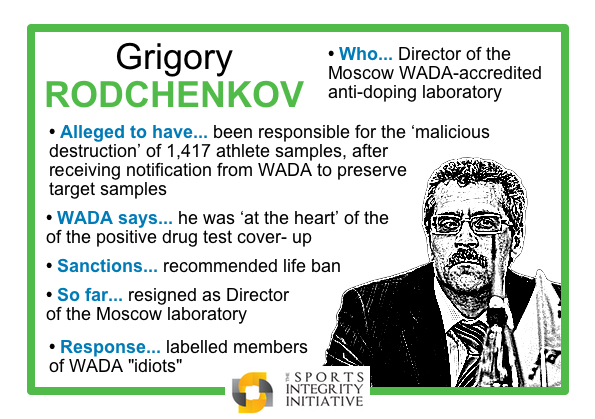
On the basis of recorded conversations between Vitaly Stepanov and the former Moscow Laboratory Director, Dr. Grigory Rodchenkov, the broadcast claims that numerous Russian athletes were doped at Sochi; including, four gold medalists that were using steroids. The broadcast also suggests that the Russian Federal Security Service (FSB) interfered with the Games anti-doping program; including, some FSB agents having been employed as Doping Control Officers (DCOs). WADA has not yet been able to independently verify these allegations, but will now conduct further inquiries into the allegations without delay. This includes initiating the process to access the recorded conversations in which Dr. Rocdhenkov aired his views, as cited in the program.

“WADA will probe these new allegations immediately,” said WADA President, Sir Craig Reedie. “The claims made in the program offer real cause for concern, as they contain new allegations regarding attempts to subvert the anti-doping process at the Sochi Games,” added Reedie. “Mr. Rodchenkov was of course interviewed by WADA’s Independent Commission that exposed widespread doping in Russian athletics last year; yet, regrettably, he was not forthcoming with such information related to the Sochi Games. It is surprising to hear these views so many months after the Commission concluded its work,” he continued.

“On behalf of WADA, I would also like to acknowledge that the Stepanovs who, as reflected by 60 Minutes and other media outlets, felt there was some level of inaction by WADA in the period leading up to the formation of our Independent Commission in January 2015,” said Reedie. “There is no question that the Stepanovs provided vital information and intelligence that allowed the Commission to be established; and, without which, widespread doping in Russian athletics may never have truly been exposed,” he continued. “What may have appeared as inaction reflected the fact that, until the revised World Anti-Doping Code came into effect on 1 January 2015, WADA did not have the power to conduct its own investigations. At the time, the Agency was only able to collect information and pass it on to those that did have the power to investigate, in this case, the Russian authorities. WADA believes that passing the whistleblowers’ information on to the Russian authorities would not have resulted in the required scrutiny.”

• This media release was initially published on the World Anti-Doping Agency’s (WADA) internet site on 10 May 2016. To access the original, please click here.

• To view the allegations in full as well as CBS News’ 60 Minutes documentary, click here.

Four year sanction for Polish swimmer Michal Zawadka

The Australian Sports Anti-Doping Authority (ASADA) today acknowledged the decision of Swimming Australia to impose a four-year ban on Polish swimmer Michal Zawadka.

Mr Zawadka was found to have committed the anti-doping rule violations of presence and use of prohibited substances Clenbuterol and methylhexaneamine. Clenbuterol is an anabolic steroid and is banned at all times and methylhexaneamine is a stimulant prohibited in competition only.

His positive sample was collected by ASADA at the NSW Short Course Championships in September 2015 as part of ASADA’s remit to test foreign athletes who train or compete in Australia.

Mr Zawadka waived his right to a hearing and as a result, accepted the mandatory four year sanction.

ASADA CEO Ben McDevitt said: “The fight against doping is a global one, and ASADA can and does test international athletes who train or compete in Australia. We are committed to ensuring our clean athletes compete on a level playing field.”

Swimming Australia imposed a mandatory provisional suspension on Mr Zawadka in November 2015 and his sanction has been backdated to take account of time already served. This means he is ineligible to participate, as an athlete or support person, in any sports that have adopted a World Anti-Doping Agency compliant anti- doping policy until 12 November 2019.

• This media release was originally published by the Australian Sports Anti-Doping Authority (ASADA) on 11 May 2016. To access the original, please click here.

FIFA Council: four-phase bidding process for 2026 FIFA World Cup™

The official activities leading up to the 66th FIFA Congress in Mexico City started with a two-day inaugural meeting of the FIFA Council, the supervisory and strategic body that sets the vision for FIFA and global football. FIFA President Gianni Infantino opened proceedings with a comprehensive report on his activities since the last FIFA Executive Committee meeting in March, most notably his visits to a number of member associations around the world and meetings with FIFA’s commercial affiliates.

Regarding the bidding process for the 2026 FIFA World Cup™, the Council agreed on a four-phase process: a new strategy and consultation phase (May 2016 – May 2017), enhanced phases for bid preparation (June 2017 – Dec 2018), bid evaluation (Jan 2019 – Feb 2020) culminating in a decision in May 2020.

The consultation phase will focus on four areas:

• The inclusion of human rights requirements, sustainable event management, environmental protection in the bidding
• Principle of exclusion of bidders that do not meet technical requirements
• Review of the current stance on joint bids
• Number of teams

While the consultation process should finish by May 2017, the decision on the number of teams, formats and the eligibility of confederations to bid is expected for October 2016.

In line with the FIFA Statutes and based on the recent decision of CAS, the FIFA Council agreed to request the amendment of the agenda of the 66th Congress in order to submit the Gibraltar FA’s application for FIFA membership under point 15.2. The vote on the admission of the Football Federation of Kosovo precedes this under point 15.1. The Council recommended that the Congress admit Kosovo and Gibraltar as the 210th and 211th FIFA members. It was also confirmed that both associations, if admitted at the 66th Congress, would be entitled to take part in the 2018 FIFA World Cup qualifiers, with UEFA tasked to define the modalities of their integration in the preliminary competition.

The Council also approved proposed amendments to the Governance Regulations, namely an improved definition of the term ‘independence’, details on the potential format of the annual associations’ conference, the inclusion of additional gender equality elements, as well as a precise definition of the remit of the Organising Committee for FIFA Competitions. The revised Governance Regulations will be published shortly on FIFA.com.

The Council also received a comprehensive report from the Audit & Compliance Committee, which welcomed the amendments to the Governance Regulations.

The procedures for the appointment of standing committees members, as well as the proposals for the election of the chairperson and members of the Governance Committee and other matters will be discussed in an additional meeting of the Council on the morning of Friday, 13 May before the Congress opens. It was also agreed that the confederations and member associations should propose members for the standing committees by 31 July 2016, after which nominees would undergo eligibility checks.

The Council also expressed its full support for the proposed new development regulations and programme which will be presented by the FIFA President at the Congress.

Further decisions taken included:

• A solidarity grant of US$500,000 for Ecuador following a severe earthquake in April. The funds will be used for renovating and reconstructing football facilities within the affected regions.
• Uruguay was appointed as the host country for the FIFA U-17 Women’s World Cup 2018 (20 November – 13 December).
• In accordance with art. 38 of the FIFA Statutes, the Benin Football Association (FBF) was suspended with immediate effect due to a recent injunction by a local judicial court which impeded the holding of the due election.
• The FIFA Congress will vote on the confirmation of the suspensions on the Football Association of Indonesia (PSSI), the Football Association of Kuwait (KFA), and the Benin Football Association (FBF).
• Ratification of the decision by the FIFA Emergency Committee not to implement the suspension of the Greek FA as the Greek Cup had been reinstated.
• Authorisation of the continued participation of New Zealand’s Wellington Phoenix in the Australian A-League for a four-year period (2016/2017 to 2020/2021 seasons).
• Ratification of the decision of the bureau of the Council to appoint a normalisation committee to run the daily affairs of the Guinea Football Federation (FGF).
• To bring forward the event dates for the FIFA Club World Cup UAE 2017 by one day to now take place between 6 and 16 December.

The next ordinary meeting of the FIFA Council in its new composition will take place on 13 and 14 October in Zurich. The deadline to elect the new additional Council members in accordance with the FIFA Statutes and the FIFA Governance Regulations is 30 September 2016.

• This media release was originally published by FIFA on 10 May 2016. To access the original, please click here. Picture credit © Getty Images.

Cricket South Africa joins Australian challenge to ICC on concussion subs

On the day of an independent review commissioned by Cricket Australia into the death of international batsman Phillip Hughes, an investigation by The Sports Integrity Initiative has learnt that the governing body of cricket in South Africa will introduce a concussion substitute policy into its domestic first-class competition. Earlier today Cricket Australia announced that it too would formally propose a concussion substitute be allowed in first-class matches.


The moves come despite the ICC’s regulations expressly forbidding the use of substitutes for injury – including concussion – in first-class cricket, with previous reports that the global body would withdraw first-class status of those matches where substitutes were used.


Under the ICC’s Classification of Official Cricket, first-class matches must be played between two sides of eleven players, and the only instance in which a playing member can be substituted to bat and bowl ‘without the match forgoing its first-class status’ must ‘relate solely to a player’s call-up to or release from international duty’. The ICC specifically states that no playing members may be replaced for reasons of injury.


ICCFirstClassMatches2


In a statement issued to The Sports Integrity Initiative, Dr Shuaib Manjra, Chair of Cricket South Africa’s (CSA) Medical Committee, said that CSA had made the decision after “considering the short and long-term health and legal risks associated with concussion”.


Last year the National Football League (NFL) in the United States of America agreed a US$1 billion settlement, without admission of liability, in order to compensate players suffering brain injuries as a result of playing American football. In 2014, the High Court in Dublin approved a €2.75 million damages settlement to a schoolboy who suffered serious head injuries playing school rugby.


“The health and safety of our players is of paramount interest to us as a cricket association,” continued Dr Manjra, who confirmed that the decision was made in a meeting of its Cricket Committee last month. “The incidents that we have seen on the cricket fields recently and the experience of other sports such as American Football should be a lesson to us that the precautionary principle is paramount.”


Cricket has recently suffered a spate of concussions after blows to the head in first-class matches. Just two weeks ago Australian international and Middlesex captain Adam Voges was hospitalised after a ‘freak head injury’ caused by an errant throw in the field. Australian opener Chris Rogers was concussed twice in two months last year after being hit on the head while batting.


“The current laws of the game prohibit substitutes in cricket but we will engage with the ICC on this topic. We believe they too will consider the matter from a player health and safety perspective.”

Shuaib Manjra quote 3


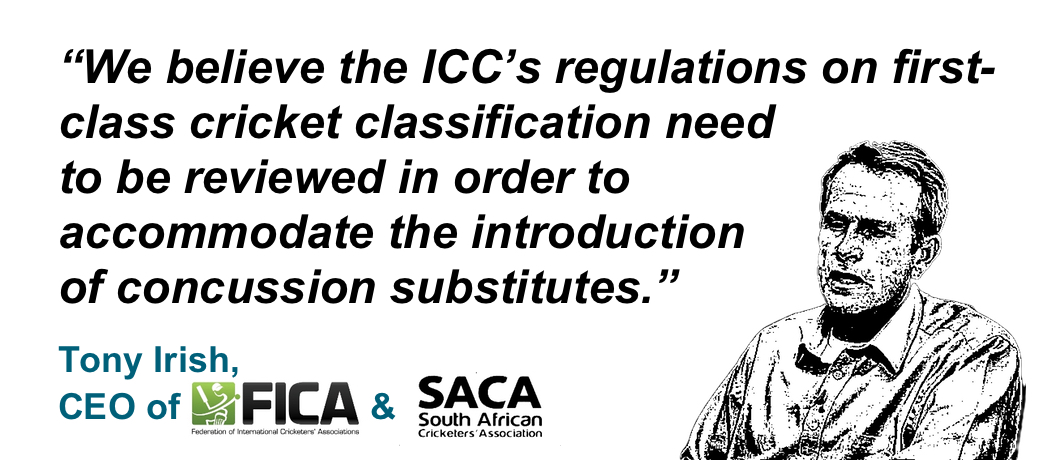
Tony Irish, CEO of both the South African Cricketers’ Association (SACA) and the Federation of International Cricketers’ Associations (FICA), said that this was a move that has received strong support from both organisations. “We believe the ICC’s regulations on first-class cricket classification need to be reviewed in order to accommodate the introduction of concussion substitutes,” Irish told The Sports Integrity Initiative. “Policies dealing with concussion should be medically and scientifically grounded.”


In response, a spokesperson for the ICC said that, while it acknowledged the risk of concussion in cricket, that the number of concussions sustained in the sport are “generally very low, particularly in relation to other contact sports”. The ICC believes that the current Laws and its playing conditions ensure that, when a player sustains a serious head injury, “he gets the best medical advice and treatment”, but that player substitution was a “broader issue” and that the ICC’s regulations had “not changed for many years”.


However the ICC told The Sports Integrity Initiative that it is in fact “considering the best approach to issuing concussion management guidance to its members,” but one of the biggest hurdles it has to overcome is “producing guidance that can be implemented and managed across the game”.

Tony Irish quote


While the ICC may be worried about the implementation of a concussion substitute, to many the leniency with which the ‘international duty’ stipulation is approached is in stark contrast to the outright refusal to allow a substitute in an instance where a batsman is hit on the head by a 90 mile per hour cricket ball.


Recently there have been concerns by both players and the media that the allowance of substitutes for players being called up for international duty is being abused, and used to disguise fatigue and workload concerns, giving teams an unfair advantage.


“I think people find it hard to digest when people get pulled out because they are going on tour, and they haven’t bowled enough and they are using it [a domestic match] as a live fitness test,” said Ed Cowan, the former Australian international and current opening batsman for New South Wales.


“But someone gets hit in the head, gets concussed, and they can’t be replaced in the same round, at the same time, and sometimes even in the same game?” asks Cowan, who was concussed and retired from a first-class match in Australia earlier this year when he was struck on the head while batting. “Then I think people struggle to register which direction the game is heading in.”


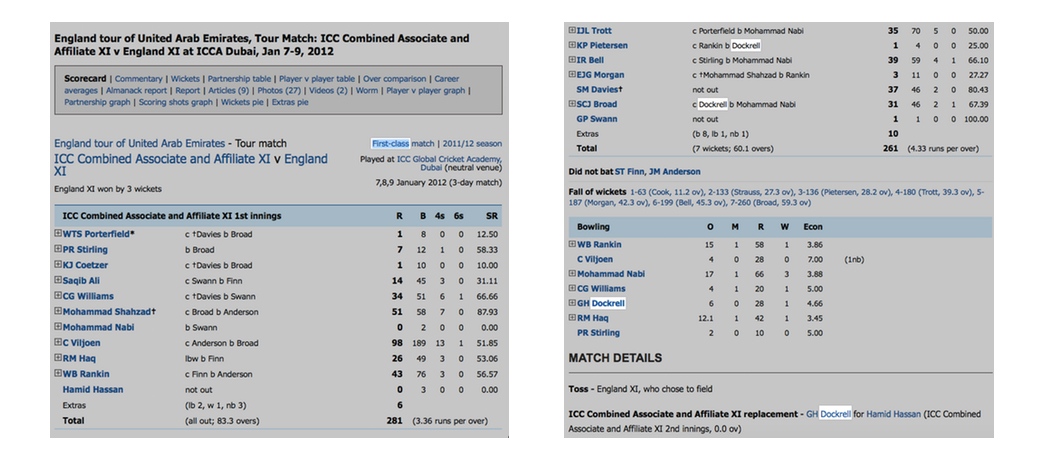
This is not the first time that questions have arisen as to the consistency with which the ICC applies its official classification of first-class cricket, and its persistent rebuttal of efforts to allow concussion, or injury, substitutes. In January 2012 an England XI played an ICC XI in Dubai when the Afghanistan fast bowler, Hamid Hassan, collided with a picket fence surrounding the ground, causing serious injury. He was replaced by George Dockrell, officially the ICC XI 12th man, but who was then allowed to bat, bowl and field. The ICC retained the first-class status of this match.


EnglandvICCsubstitute
The scorecard from the first-class match between an ICC Combined Associate and Affiliate XI v England XI in 2012 // ESPNcricinfo


A Cricket Australia spokesman confirmed to The Sports Integrity Initiative that in 2012 they had “campaigned unsuccessfully” to introduce a structured concussion substitutes replacements code. A plan to trial a formal substitutes system was reportedly aborted after senior figures were ‘made aware’ that the premier Sheffield Shield competition would lose its first-class status if the move went ahead.


An ICC spokesperson said that a further Cricket Australia proposal to introduce injury substitutions in first-class cricket was rejected by the ICC Cricket Committee in 2014 with very little support.


Cricket Australia said that its position on concussion substitutes remains unchanged. Following the release of the independent Curtain review into Phillip Hughes’ death, Cricket Australia, in a similar vein to Cricket South Africa, have once again proposed that a concussion substitute be introduced in first-class cricket, despite the ICC’s current stance.


Both the England and Wales Cricket Board (ECB) and Cricket Australia have informal concussion protocols in place which stipulate that ‘any player with a suspected concussion must be removed from the field of play and undergo stepwise assessments’.


The ECB's Head Injury & Concussion Guidelines 2015 // England & Wales Cricket Board
The ECB’s Head Injury & Concussion Guidelines 2015 // England & Wales Cricket Board


However both players and administrators at the national level are becoming increasingly frustrated, and disillusioned, with the disconnect between the ICC’s refusal to allow substitutes and the strict concussion protocols enforced by the national boards.


“There are people far brighter than me that know the ramifications of getting hit in the head,” said Angus Fraser, the Managing Director of Cricket at Middlesex, speaking after Adam Voges’ concussion. “But the fact is that it is your responsibility to look after your players and do what is best for your players.


“To some extent you could be compromised by the desire to win or avoid defeat in a game of cricket,” said the former England fast bowler. “I think a player is more likely to hide the fact that they have been concussed and that can’t be good.”


For many players, it is considered a badge of honour to play on and ‘knuckle down’ when faced with injury and adversity. “Shows the character of the bloke,” said New Zealand fast bowler Neil Wagner after Australian captain Steve Smith was struck on the head but batted on in a Test match earlier this year. Cricket Australia said that in this instance all concussion protocols were met and passed by Smith.


“The Laws and Regulations have got to adapt to the modern world. That’s why technology is so involved, because we know so much more than we knew before,” said Fraser.


Angus Fraser quote


In an unfortunate coincidence, when Cowan was hit and concussed in Australia earlier this year, Voges was the opposing captain for Western Australia. When Cowan was hit, Voges had come into the New South Wales dressing room and offered to replace Cowan. Cricket Australia, in fear of the wrath of the ICC, told him that such a move would void the game as a first-class match.


According to Fraser a similar discussion took place at Hampshire last week when Voges was concussed. “I think Giles White [Hampshire’s Director of Cricket], and Richard Scott [Middlesex Head Coach] – I don’t know how far they pushed it – were certainly in conversation that morning,” said Fraser. “And it did sound like Hampshire would have been prepared to have allowed us to get a substitute to take full part in the game. Obviously it didn’t get off the ground.”


For Tony Irish, the move by the national cricket boards in the face of ICC inaction is a long time coming. “We believe that cricket should be brought into line with what is happening in other global sports,” said Irish. “I believe that if other boards join with this approach the ICC are likely to review those regulations. I would be surprised if they don’t.”


The ICC claims there are many hurdles to introducing a new rule, such as the difficulty of ensuring its global implementation and management, that it would be “difficult to justify a rule only for concussion and not for other types of injury”, and that it has only failed to act on the issue thus far because it did not want to be seen as a “regime of regulation, policing and sanction”.


With the ICC’s Cricket Committee set to have its next annual meeting on 31 May, the governing body has conceded that it will at least discuss the proposals issued by the national cricket boards.

Anti-Doping Rule Violation asserted against CIS Player

The Canadian Centre for Ethics in Sport (CCES) announced today that under the rules of the Canadian Anti-Doping Program (CADP), it has asserted an anti-doping rule violation against Jonathan Fortin, a Canadian Interuniversity Sport (CIS) athlete affiliated with Bishop’s University. The athlete’s urine sample, collected during out-of-competition doping control on March 9, 2016, revealed the presence of Methandienone, a prohibited anabolic agent.

Under the rules of the CADP, the athlete has the right to pursue a hearing to contest CCES’ assertion of a violation. His case remains open until he either waives this right or pursues a hearing. At this point, Mr. Fortin does not have an anti-doping rule violation.

Rule 14.3.1 of the CADP provides the CCES with the authority to publicly disclose the identity of an athlete against whom the CCES has asserted an anti-doping rule violation. The CCES has exercised this authority given Mr. Fortin is eligible for the Canadian Football League’s (CFL) draft on May 10, 2016.

• This media release was originally published on the Canadian Centre for Ethics in Sport (CCES) internet site on 10 May 2016. To access the original, please click here.

Something to die for: Rebutting the Mirkin & Goldman dilemma

When news about the Russian doping scandal broke in 2015, it hit headlines everywhere. Organisations directly involved – such as like the World Anti Doping Agency (WADA), the International Olympic Committee (IOC) and the International Association of Athletics Federations (IAAF) – felt action was immediately needed, as did a number of governments around the world. Consequently, in January 2016, the Chief Executive Officer of UK Anti-Doping, Nicole Sapstead, was called upon as witness in a parliamentary inquiry that emerged from the IAAF blood files expose[1]. When answering a question on why she did not think criminalising doping would have the necessary deterrent effect, she said:

“There was one study where a group of athletes or sportspeople were asked, ‘This is a magic pill and, if you take this magic pill, it will assure you that you can win your competition event. You will be top of the game, would you take it?’ Startling, over 50% said of course they would take it. You then overlay that with, ‘If we then told you that in five years’ time, as a consequence of taking that magic pill, you would die would you still take it?’ You would expect the response rate to drop significantly but, no, it didn’t. So I could equally argue that a criminal charge, death—if you are prepared to dope I wonder if either of those two are something that you would consider.”

In emphasising the extraordinary mind-set athletes are equipped with and the challenges this may cause for educators and legislators, Sapstead subscribes to an idea about drug use and elite sport that has been circulated in academia and journalism for decades. Not only have many people heard that athletes are willing to die for a medal, the idea is so powerful that – as evidenced by Sapstead’s use of it – it may influence legislation in the area. This exceptionalism of the athlete psyche, we are told, is one of the most important reasons why it is so difficult to combat doping.

Athletes will die for a medal

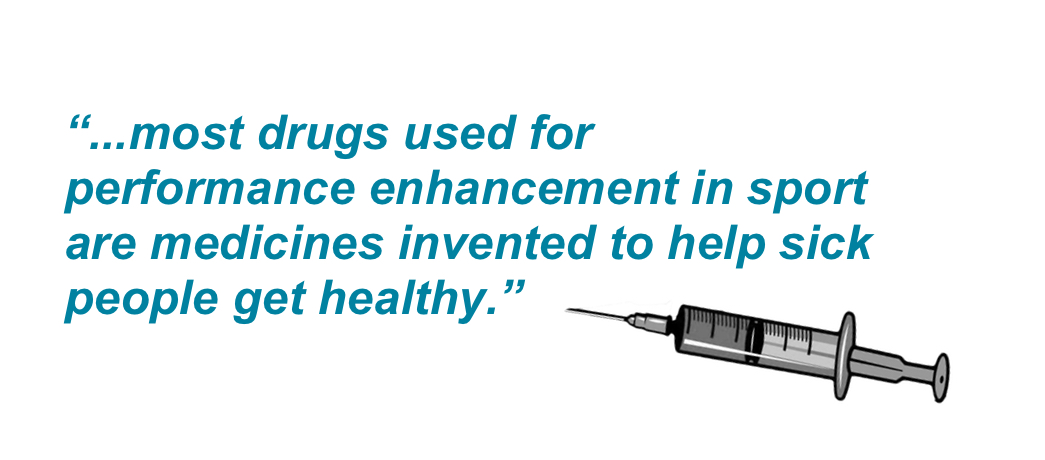
Let us put one thing straight: Athletes are willing to put their health at risk for sporting achievements. That proposition can be confirmed by a number of sports such as boxing, cycling, American football and downhill skiing, just to name a few. In that regard, sport is a place where people can risk their health and get intense experiences in return. The will to take risks, however, is not an expression of carelessness towards the body. Athletes depend on their body to perform, so they takeDrugssickpeoplehealthy care of it every day. The fact that athletes dope in order to be competitive does not counter this. It is worth remembering that most drugs used for performance enhancement in sport are medicines invented to help sick people get healthy. Not the opposite. Few athletes who make a living from their sport would consume substances with no considerations at all. They might have a careless attitude to diet supplements, vitamins and maybe also painkillers (Roderick, Waddington, & Parker, 2000), but when it comes to more potent drugs or actual doping substances or methods, they will reflect on the consequences of what they are doing. AthletessubstancesconsiderationSo, one cannot extrapolate from the fact that athletes take risks to a proposition saying that they are willing to take years off of their life swallowing a lethal substance just to win, set a record, or have a chance at a professional contract. They are not willing to die for a medal, as it is often claimed. How then, did this become accepted wisdom?
The Mirkin survey

When discussing educational campaigns’ lack of ability to convince athletes to stay clear of drugs, scholars and anti-doping officials have for many years sought to explain this by reference to the well-known ‘fact’ that the wish to win Olympic gold – in some cases – eliminates all rational considerations. In line with Sapstead, as evidence they often refer to a nearly forty-year-old survey that has reached almost mythological status. This was, for instance, what sociologist Ivan Waddington did in his review of doping in British sport. Waddington points to the naiveté he thinks dominated when an official report on the problem of doping argued that if only athletes had sufficient knowledge on the side effects of drugs, they would refrain from taking them. He emphasises the report’s lack of awareness of the power of athletic ambition, and states:

‘Nor did they [the authors of the report] refer to Mirkin’s study of over a hundred competitive runners, more than half of whom indicated that they would take a “magic pill” that guaranteed them an Olympic gold medal, even if it would kill them within a year’. (Waddington, 2005, p. 482; Waddington & Smith, 2009, p. 111).

Mirkin’s study is indeed the classic evidence on athletes’ carelessness. However, a number of basic facts about the study remain unknown: How exactly was it undertaken? How many runners were surveyed? Who were they? What was the response-rate? What was the exact question they were asked? Were the answers distributed as ‘Yes’ and ‘No’ or was it a Likert-type scale? To the best of my knowledge, no sources that make a thorough account of the study exist. It is nevertheless often repeated as fact. When browsing through the literature referring to the survey, it is surprising to see how some present Mirkin’s question in one way, others slightly differently. However, none reproduced the original question directly or offered a reference to the source. Instead, scholars typically refer to one of two other works. The first – which Waddington for instance cites – is an article by the American sports historian Terry Todd. Todd mentions Mirkin’s survey, paraphrases his question and reports the result in a similar manner to Waddington above (Todd, 1987). However, the source Todd thereafter cites is not Mirkin, but an article on the subject in the San Diego Union newspaper from 1982[2]. That article has itself no references to the source of the information. The other work typically referred to is the American sport physician Bob Goldman’s book Death in the Locker Room from 1984. Goldman also mentions Mirkin’s survey, but again without any specific reference to it. He makes it known, though, that Mirkin is the (co)author of ‘the famous’ Sports Medicine Book (Goldman, Bush, & Klatz, 1984). To my knowledge, this book is the closest one can get to the original source. However, it is interesting to note that in his book, Mirkin only mentions his survey in passing. In the chapter on drugs, he lets us know that:

‘A few years ago I polled more than a hundred top runners and posed this question: “If I could give you a pill that would make you an Olympic Champion – and also kill you in a year – would [you] take it?”’

He thereafter states that: ‘To my amazement, more than half of the athletes responding stated that they would take my magic pill’ (Mirkin & Hoffman, 1978, p. 84). That is all! No further references or other details. Mirkin indicates that not all of the ‘more than hundred top runners’ responded to the question. But how many actually did respond remains unknown.

Nevertheless, the result’s shocking implications for our understanding of drugs, sport and athletes’ extraordinary psychological constitution has apparently been sufficient for many scholars to think that it needed to be passed on. However, the unclear status of the source and the lack of precise data have made authors add and subtract on the content as they have seen fit. Thus, in one of the main works on doping in sport written in the 1980s, Foul Play, the British scientists Tom Donohoe and Neil Johnson open their chapter on the future of sport in this way:

‘In a survey conducted by Dr. Gabe Mirkin, over a hundred top American athletes were asked if they were given the option of taking a drug which would make them an Olympic champion but which could kill them within a year, would they take it? Almost 55 per cent of the sample said they would take the drug (Donohoe & Johnson, 1986, p. 125 emphasis in original)’.

Four things are worth pointing out. First, in this account of the survey it is no longer top runners, but ‘American top athletes’ in general who took the survey. Second, now the drug the athletes were asked to consider was not described as something that would kill them, but merely as something that could kill them. Third, there is an apparent clarification in that it was almost ‘55 per cent of the sample’ who answered in the affirmative. And finally, it is surprising to learn that Donohoe and Johnson does not reference Mirkin, Todd nor Goldman as their source of the information, but a completely unspecified ‘Northern Ireland Institute of Coaching article’ (Donohoe & Johnson, 1986, p. 175).

When looking through texts forwarding the Mirkin study’s result, it is usually stated that around half of athletes are willing to exchange their life for a medal. However, the American journalist Will Carroll made a different claim. In his 2005 book on drugs in American baseball, The Juice, I found the most extreme example on narrating the survey. His book opens promising with a foreword saying how important it is to get rid of myths and hearsay, because ‘the intellectual sloppiness rampant in most steroid screeds […] is in many ways far more dangerous than the steroids themselves’ (Carroll, 2005, p. X). But later, when referencing the Mirkin study in his discussion of athletes’ fanatical desire for glory, he lets us know that: ‘Astonishingly, more than 90 percent of those polled said they would take the substance’ (Carroll, 2005, p. 231)[3].

Given this background – the uncertainty of the actual design, content and results of the study, but also the lack of reliable references – it seems reasonable to suggest that Mirkin never actually performed a ‘poll’ of ‘more than hundred top runners’ – at least not in the way researchers typically use this term. Instead, his poll was more like the casual poll one might pass on to colleagues at a meeting to ascertain whether the new walls should be painted white or grey.  So, a more accurate explanation is that Mirkin did in fact pose his question to the runners, but he did not do so as part of a genuine scientific survey, following basic methodological guidelines. For this reason, he only mentions the response in passing in his book, but did not describe or publish it as an independent piece of research. To the extent that ‘a survey’ was actually carried out, Mirkin perhaps informally queried the athletes he worked with as part of his profession as a sport physician without ever intending the results to be anything more serious. As he gradually collected the answers, he may have written them down or simply just relied on his memory. Later, he used this as a striking, albeit slightly misleading, introduction to his chapter on performance enhancing drugs to illustrate how dangerous a temptation doping is. Such approach is in line with the defensive attitude to doping in the 1970s, where the actual physiological effects of the drugs were often deliberately downplayed as part of an educational strategy trying to convince athletes that drugs were of no use. In keeping with this, after having presented his shocking finding in his book, Mirkin emphasises that ‘[t]he psychological dependence on drugs is the main reason they are used today’ (Mirkin & Hoffman, 1978, p. 84).

The Goldman Dilemma

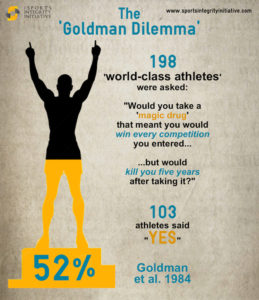
Maybe because he could not validate the source, or simply wished to find out whether it was only runners that were so fanatic, a few years later Bob Goldman conducted his own survey. It is that survey which has been famously known as the ‘Goldman Dilemma’. Goldman states that his survey – except for replacing runners with track & field and power athletes – mirrors that of Mirkin. He goes on to give a few more details than his predecessor does. He thus posed the following question to 198 so-called ‘world class athletes’:

‘If I had a magic drug that was so fantastic that if you took it once you would win every competition you would enter, from the Olympic decathlon to Mr Universe, for the next five years, but it had one minor drawback – it would kill you five years after you took it – would you still take the drug?’ (Goldman et al., 1984, p. 32).To this question, also more than fifty percent – 103 athletes (52 percent) – apparently replied in the affirmative. Against this background Goldman thinks, and many has followed him, that the claim about athletes’ extreme willingness to take risks when Olympic gold is at stake is justified. However, as the Canadians Rob Beamish and Ian Ritchie rightly point out, Goldman’s question is even more absurd than Mirkin’s (Beamish & Ritchie, 2005). The premise is too fantastic and too unrealistic to be taken seriously[4].

Over many years of intensive training, athletes know how their bodies adopt to their discipline, therefore to win ‘every competition you would enter’ is simply comic book nonsense. This absurdity in Goldman’s GoldmanDilemmaquestion may also be the reason why many scholars, when referring to the accepted wisdom of athletes’ carelessness, chose to paraphrase Mirkin’s question but combine it with Goldman’s results. That is, they rely on Mirkin’s premise to promote Goldman’s conclusion.
Just for those reasons, it is highly doubtful whether the athletes would have provided the same answer if the inquirer had had the pill in his hand, and they had to swallow it on the spot if they answered ‘yes’. Goldman is actually aware that the athletes might have reacted differently if such a pill actually existed. However, immediately after mentioning this precaution, he chose to disregard his own logic and states that: ‘Perhaps this argument is correct, but the evidence suggests otherwise’ (Goldman et al., 1984, p. 32). However, Goldman does not provide any evidence.

As noted above, the point here is not to deny that athletes are willing to make big sacrifices in orer to fulfil their ambitions, but simply to stress that, despite this, there are limits to how far they are willing to go. It was therefore praiseworthy when a group of doping scholars decided to re-test Goldman’s findings and said something along the lines of: ‘Okay, let’s see if we can replicate Mirkin’s and Goldman’s results, but in surveys and with questions operating under a proper methodological design’. GoldmanDilemmaRevisited
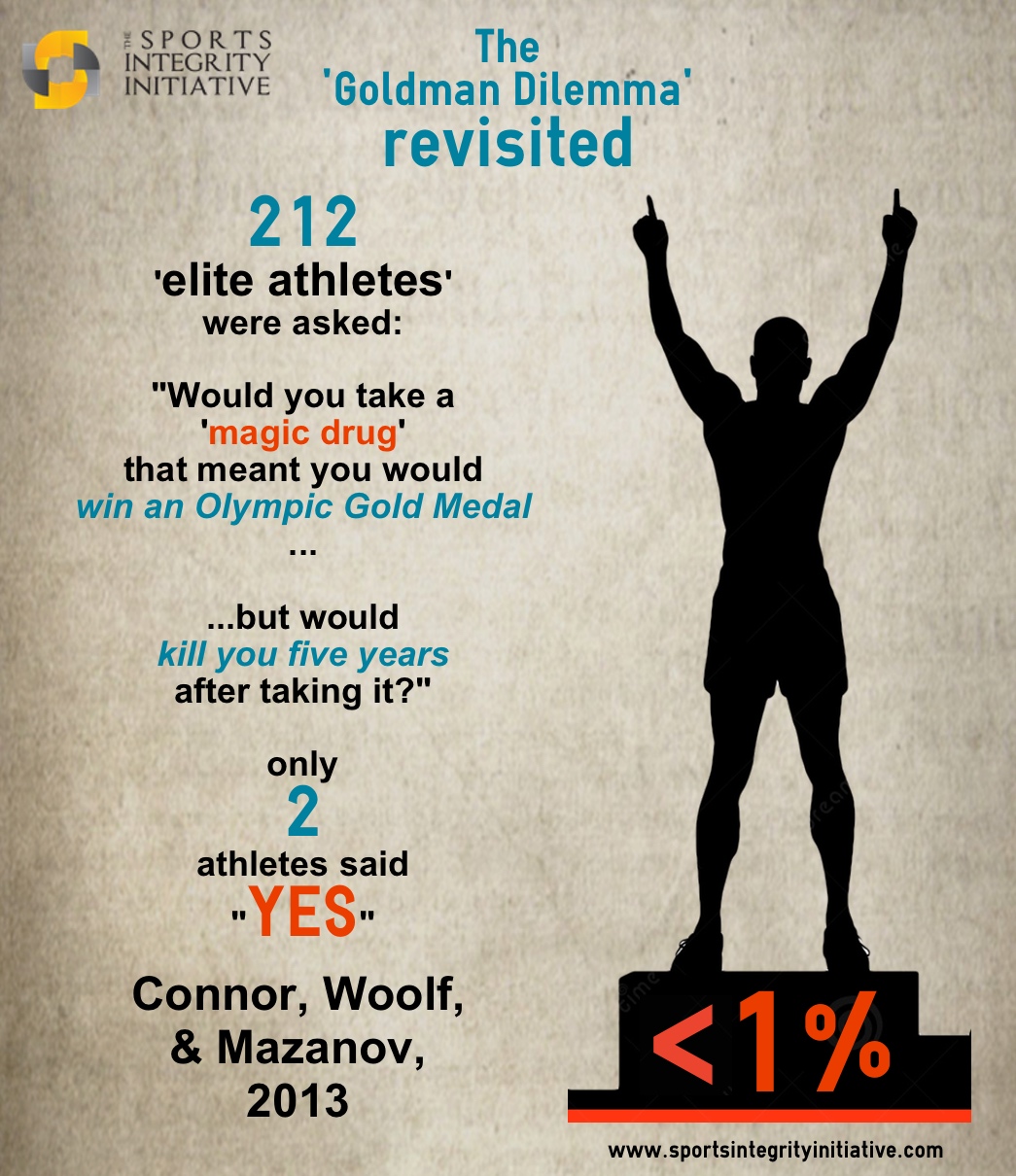
The result was not surprising: ‘Only 2 out of 212 samples reported that they would take the Faustian bargain offered by the original Goldman dilemma’ (Connor, Woolf, & Mazanov, 2013). Connor and colleagues found this even if the question they posed was not as unrealistic as Goldman’s was – it was not ‘every competition’, but ‘only’ ‘an Olympic Gold Medal’ the respondents could win. Thus, among present day elite athletes, less than one percent would apparently be ready to take the substance. Moreover, their attitude mirrors that of the general population: When a representative sample was asked the same question, also less than one percent accepted the bargain (Connor & Mazanov, 2009). So, even if the desire to win is an essential element in elite athletes’ psychology, they are not equipped with an extraordinary psyche that makes them willing to die for a medal[5].

However, the results from the Mirkin survey and Goldman dilemma are still repeated and used as evidence pertaining to the extraordinary athletic mind-set, as we saw in the recent government inquiry featuring Nicole Sapstead, CEO of UKAD. For three reasons this repetition is, if not deadly, then at least unhealthy for sport. First, it undermines the trustworthiness of those officials, academics and journalists forwarding the nonsense. Second, on false premises it risks influencing legislation, rules, regulations and educational campaigns; for instance by introducing excessive monitoring of athletes through anti-doping, as they cannot be trusted to manage their own drug use. Third, it reproduces two other of today’s major prejudices about drugs and sport. One is that the premise of the question (‘it would kill you’), contributes to the misperception that doping drugs are deadly[6]. The other, that the result (‘more than half…’) portrays athletes as sports idiots in the most literal sense of the word.

As the past decade’s revelations in sports such as athletics, cycling, and baseball have clearly demonstrated, there certainly are enough issues to tackle when it comes to the use of drugs in sport. We should focus on these instead of wasting energy battling unsubstantiated myths that draw our resources and attention in the wrong direction. Let’s get real!

Footnotes

[1] See more at e.g. (The Sunday Times, 2015).

[2] ‘High Risk Gamble to Obtain Winning Edge’, San Diego Union, 13 July 1982.

[3] Carroll also makes up his own formulation for the question asked. In his version of the Mirkin study, it was young athletes that were polled, and their suicidal tendencies were not only exposed if Olympic gold were at stake, but also if they could win a national championship. ‘The desire for glory is exemplified in a survey that asked young athletes if they would take a drug that would guarantee them an Olympic gold medal or national championship, even if they knew the substance would cause them to die within five years. Astonishingly, more than 90 percent of those polled said they would take the substance’ (Carroll, 2005, p. 231).

[4] As point of departure for their criticism of Goldman’s study, Beamish and Ritchie also mentions Mirkin’s survey. But even they have no reference to the source. They restrict themselves to reference Goldman.

[5] To be fair, as the point of departure for their study, Connor, Woolf and Mazanov do not really question the validity of Goldman’s survey. They accept its findings as valid, but wants to see whether the result can be reproduced 30 years later. When finding that it cannot, the authors offer a number of explanations on the observed difference. The most important being a significant difference in legality and acceptance of drugs in sport when comparing the early 1980s with the 2000s. Between the two studies, WADA entered the stage and the national and international sport bodies’ position on doping and the athletes’ attitude to drugs changed dramatically. Hence, according to the authors, the difference in result is not a consequence of the design of the respective studies, as I argue, but simply reflects changing attitudes over time (Connor et al., 2013).

[6] As pointed out above, most doping drugs are medicines developed to help sick people get well. In fact, very few, if any, elite athletes have died from doping. Even the fatality of a known doper does not reliably give us causality. Millions of elite and non-elite athletes have survived years of doping.

References

• Beamish, R., & Ritchie, I. (2005). From Fixed Capacities to Performance-Enhancement: The Paradigm Shift in Science of ‘Training’ and the Use of Performance-Enhancing Substances. Sport in History, 25(3), 412-433.

• Carroll, W. (2005). The Juice: The real story of baseball’s drug problems. Chicago: Ivan R. Dee.

• Christiansen, A. V., & Møller, V. (2007). Mål, medicin og moral: om eliteatleters opfattelse af sport, doping og fairplay (Ambitions, drugs and morality: On elite athletes’ attitudes to sport, doping and fair play). Odense: University Press of Southern Denmark.

• Connor, J. M., & Mazanov, J. (2009). Would you dope? A general population test of the Goldman dilemma. Br J Sports Med, 43(11), 871-872. doi:10.1136/bjsm.2009.057596

• Connor, J. M., Woolf, J., & Mazanov, J. (2013). Would they dope? Revisiting the Goldman dilemma. Br J Sports Med, 47(11), 697-700. doi:10.1136/bjsports-2012-091826

• Donohoe, T., & Johnson, N. (1986). Foul Play: Drug Abuse in Sports (Reprinted ed.). Oxford, New York: Basil Blackwell.

• Goldman, B., Bush, P. J., & Klatz, R. (1984). Death in the locker room: Steroids & sports. London: Century Publishing.

• Mirkin, G., & Hoffman, M. (1978). The Sports Medicine Book. Boston: Little, Brown and Company.

• Roderick, M., Waddington, I., & Parker, G. (2000). Playing Hurt: Managing Injuries in English Professional Football. International Review for the Sociology of Sport, 35(2), 165-180. doi:10.1177/101269000035002003

• The Sunday Times. (2015). The Doping Scandal. Retrieved from http://features.thesundaytimes.co.uk/web/public/2015/the-doping-scandal/index.html#/

• Todd, T. (1987). Anabolic steroids: The gremlins of sport. J.Sport Hist, 14(1), 87-107.

• UK Culture Media and Sport Committee. (2016). Oral evidence: Blood Doping in Athletics, HC 430, Tuesday 26 January 2016. http://data.parliament.uk/writtenevidence/committeeevidence.svc/evidencedocument/culture-media-and-sport-committee/blood-doping-in-athletics/oral/28038.html.

• Waddington, I. (2005). Changing patterns of drug use in British sport from the 1960s. Sport in History, 25(3), 472-496.

• Waddington, I., & Smith, A. (2009). An introduction to drugs in sport: Addicted to winning? (2. ed. ed.). Abingdon: Routledge.

• This text is rewritten and expanded version of a section appearing in the Danish language book by Christiansen & Møller, 2007, pp. 127-130.

Reaction to CAS reduction of Platini ban

This morning the Court of Arbitration for Sport (CAS) found that the six-year suspension imposed on Michel Platini by FIFA was too severe and should be reduced to four years, despite also being ‘not convinced by the legitimacy’ of a CHF 2,000,000 (€1,800,00) payment from FIFA. Since the announcement of this decision, FIFA, UEFA and Michel Platini himself have responded with statements:


Michel Platini statement

I take note of the decision from the Court of Arbitration for Sport but I view it as a profound injustice.

This decision inflicts on me a suspension that effectively, as luck would have it, stops me from contesting the next FIFA presidential election.

As agreed with the national associations, I am resigning from my duties as UEFA president to pursue my battle in the Swiss courts to prove my innocence in this case.

Life is always full of surprises: I am henceforth available to experience more of them.


UEFA statement on Michel Platini

UEFA has taken note of the decision of the FIFA Ethics Committee to suspend Michel Platini for eight years from all football-related activities.

Naturally UEFA is extremely disappointed with this decision, which nevertheless is subject to appeal.

Once again, UEFA supports Michel Platini’s right to a due process and the opportunity to clear his name.


FIFA statement

FIFA has acknowledged the decision rendered today by the Court of Arbitration for Sport (CAS) in the case involving Michel Platini, which has partially maintained the decision taken by the FIFA Appeal Committee on 24 February 2016.

In particular, by lowering the sanction from six to four years and the CHF 80,000 fine to CHF 60,000.


Rodchenkov: four Russians on steroids won gold at Sochi 2014

Four of the 14 gold medals won by Russians at the Sochi 2014 Winter Olympics were won by athletes on steroids and the Moscow anti-doping laboratory helped cover it up, alleges its former Director, Grigory Rodchenkov. He also alleges that the Russian federal security service (FSB) facilitated this by managing the testing process at Sochi 2014, with agents working as Doping CWADAprofiles_GRodchenkovontrol Officers (DCOs).

The extraordinary claims come from 15 hours of communication between Rodchenkov and former Russian Anti-Doping Agency (RUSADA) employee Vitaly Stepanov (pictured), both of whom are now living in the US for their own protection. Stepanov recorded the communications and passed them on to CBS News, which featured them in a ’60 Minutes’ documentary (featured below). Rodchenkov also told Stepanov about a ‘Sochi List’ of of doped Russians who competed at the Winter Olympics.

“WADA has watched the CBS 60 Minutes program, which revealed new and very disturbing allegations regarding Russian doping in sport”, said a World Anti-Doping Agency (WADA) spokesperson. “We will look into these without delay”.

Regulations prevent WADA & IAAF from reacting

It appears that the internal regulations of WADA and the IAAF delayed both bodies in reacting to Stepanov’s information. Stepanov revealed that he had warned the World Anti-Doping Agency (WADA) about systemic doping in Russia by sending it over 300 emails and 50 letters over a three-year period. Stepanov says he was told that WADA had no power to investigate inside Russia, and pushed him towards journalist Hajo Seppelt, who used his information to create his December 2014 documentary. This tallies with a December 2014 statement, in which WADA says it had ‘already received some information and evidence of the type exposed in the documentary’.

“Before 2015, WADA didn’t have the authority to conduct its own investigations under the World Anti-Doping Code”, explained a WADA spokesperson. “At the time, we were only able to collect information and provide it to those that did have the power to investigate; in this case, the Russian authorities. The Stepanovs provided us with very valuable information; however, we did not have the confidence that passing the information onto the Russian authorities would have led to the scrutiny required. And above all, we feared that in passing the information to the Russian authorities, the health and safety of the Stepanovs would have been at serious risk. As soon as we did have the power to investigate (under the revised World Anti-Doping Code, which came into effect on 1 January 2015), we acted without hesitation by forming the Independent Commission. This was done at the earliest opportunity.”

In its December 2014 statement, WADA says that it passed the information to the International Association of Athletics Federations (IAAF). In November last year, The Sports Integrity Initiative uncovered that the IAAF had been investigating allegations that Russian sporting officials colluded with the IAAF since April 2014. However, its own internal regulations meant senior IAAF officials were not aware that any investigation was taking place until January 2015.

“The only independent body to which this reference could conceivably relate is the IAAF Ethics Board and, if so, only the Ethics Board and WADA would know when and what information was passed between them”, said an IAAF spokesperson. Up until the IAAF changed its rules in November last year, Ethics Board proceedings were confidential. ‘The members of the Ethics Commission shall ensure that everything disclosed to them during the course of their duties remains confidential, including the facts of any case or issue and any deliberations or decisions that are taken’, reads Statute G of the IAAF Code of Ethics.

The IAAF itself was not aware of any referral until Stepanov approached it directly in January 2015. “I have spoken to the Medical and Anti-Doping Department and they are not aware of WADA having ever referred Mr Stepanov’s concerns to the IAAF”, continued the spokesperson. “They confirm that Mr. Stepanov was in contact with the Department in January 2015, but that it was a personal approach by him to the IAAF. By that time, IAAF staff had already referred the Shobukhova matter to the IAAF Ethics Commission (now the Ethics Board) some nine months earlier in April 2014. By the time the ARD documentary was aired in December 2014, the IAAF Ethics Board had been investigating the matter for six months.”

Bribery & fake tests

Stepanov said that he refused a bribe offered by the Vice-President of the Russian Athletics Federation (RusAF) if he could prevent a certain athlete from being tested. “That official comes to me and he says: ‘this athlete cannot be tested. How much money do you need?’” When he told RUSADA, he was told: “What happens in Russia stays in Russia”.

He also alleged that on their first date, Yuliya Stepanova (then Yuliya Rusanova) told him that all her teammates were doping as well as her, and it was her impression that RUSADA was there to help athletes win medals by doing “fake” testing. As featured in Seppelt’s December 2014 documentary, video footage recorded by Stepanova on her mobile phone details the team’s Medical Director telling her how to get back on the doping programme. “It’s hard to believe that you are doing something wrong when everybody around you says that it is right, and there is no other way that you are shown”, says Stepanova, who confessed to taking erythropoietin (EPO), testosterone, trenbolone and barabolin (steroids) in the documentary.

Implications

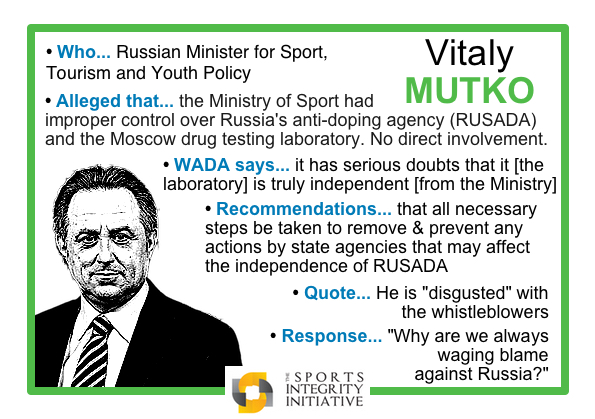
“It’s clearly the final nail in the coffin for Russian track and field”, said US Anti-Doping Agency (USADA) CEO Travis Tygart in the documentary. However Vitaly Mutko, Russian Minsiter for Sport, appeared to disagree, dismissing the accusations as “speculation” in an interview with Russian news agency TASS. WADAprofiles_VMutko“Soon our athletes will have to perform at the Olympic Games in Rio de Janeiro”, Mukto continued. “It is obvious that someone wants to harm Russian sports. Stepanov has exhausted the topic of doping in athletics, now he has started with the Sochi Olympics. What facts does he have, what lists? Why did he decide to make another revelation now?”

On 17 June, the IAAF Council will decide whether it can re-admit Russia ahead of the Rio 2016 Olympics at its meeting in Vienna. At the Sports Resolutions conference last week, UK Athletics Chairman Ed Warner said that it would be unfair to ban just Russian athletics, since other sports were also tested by RUSADA during the period in question. Yuliya Stepanova has also petitioned the IAAF Council to compete as an independent athlete at Rio 2016.

If she is allowed to compete, will other Russians also be allowed to compete under an independent flag? If so, how many? Who will test them? Banning some Russians but not others may result in accusations of unfairness. It is no wonder that evidence has been uncovered that the International Olympic Committee (IOC) has been discussing the situation with the IAAF at April’s SportAccord convention. Mark 17 June in your dairy now…

Court of Arbitration for Sport lowers Platini suspension to 4 years

The Court of Arbitration for Sport (CAS) has rendered its decision in the arbitration procedure between Michel Platini and the Fédération Internationale de Football Association (FIFA). The suspension of Mr. Platini has been lowered from 6 to 4 years and the CHF 80’000 fine to CHF 60’000.

On 26 February 2016, Michel Platini filed an appeal at the CAS to request the annulment of the decisions issued by the Adjudicatory Chamber of the FIFA Ethics Committee and by the FIFA Appeal Committee suspending him for 6 years from any football-related activity at a national and international level and imposing upon him a fine of CHF 80’000.

The CAS arbitration procedure was submitted to an arbitral Panel composed of Prof. Luigi Fumagalli, President (Italy), Prof. Jan Paulsson (France) and Prof. Bernard Hanotiau (Belgium). A hearing took place at the CAS headquarters in Lausanne, Switzerland on 29 April 2016.

The arbitral Panel noted the existence of a valid employment contract between Michal Platini and FIFA, signed in 1999 and including an annual salary of CHF 300’000. Such contract was performed by the parties and terminated in 2002 when Mr. Platini became a member of the FIFA Executive Committee. It was not until 1 February 2011 – 4 months prior to the FIFA presidential elections and at a moment when Sepp Blatter and Mohamed Bin Hammam were both still candidates to the election – that FIFA paid the amount of CHF 2’000’000 in favour of Mr. Platini. Mr. Platini justified such payment as back pay, explaining that he had orally agreed with Mr. Blatter in 1998, when the future FIFA President was negotiating with him, to an annual salary of CHF 1’000’000. The Panel, however, was not convinced by the legitimacy of the CHF 2,000,000 payment, which was only recognized by Mr. Platini and Mr. Blatter, and which occurred more than 8 years after the end of his work relations, was not based on any document established at the time of the contractual relations and did not correlate with the alleged unpaid part of his salary (CHF 700’000 x 4 = CHF 2’800’000). Moreover, the Panel took note that Mr. Platini benefitted from the extension of a pension plan to which he was not entitled.

Consequently, the CAS arbitrators unanimously determined that Mr. Platini obtained an undue advantage in breach of Article 20 of the FIFA Code of Ethics. Furthermore, the Panel also found Mr. Platini guilty of a conflict of interest in breach of Article 19 of the FIFA Code of Ethics.

Based on such findings, the CAS Panel considered that the suspension imposed by FIFA on Mr. Platini was nevertheless too severe and therefore decided to reduce such suspension to 4 years, which corresponds to the duration of a presidential term. The CAS Panel was of the opinion that a severe sanction could be justified in view of the superior functions carried out by Mr. Platini (FIFA Vice- President and UEFA President), the absence of any repentance and the impact that this matter has had on FIFA’s reputation. Contrary to the decisions challenged, the Panel considered that Mr. Platini could not be sanctioned for the violation of Articles 13 (general rules of conduct) and 15 (loyalty) of the FIFA Code of Ethics as the application of Articles 19 and 20 of the FIFA Code of Ethics (special rules) excluded the application of Articles 13 and 15 (general rules) irrespective of the Panel’s findings that Mr. Platini’s behaviour was not ethical or loyal. In addition, the Panel noted that FIFA knew of the CHF 2,000,000 payment in 2011 but initiated an investigation into Mr. Platini’s behaviour with the FIFA Ethics Committee in September 2015 only.

Finally, the Panel also reduced the fine imposed on Mr. Platini in a similar proportion and set it at CHF 60’000.

The arbitral award with the grounds will be notified to the parties concerned in a few weeks.

• This media release was originally published by the Court of Arbitration for Sport (CAS) on 9 May 2016. To access the original, please click here.