


The trouble with Ostarine: Jimmy Wallhead’s
16th March 2018
Features


Twenty athletes from 14 countries, competing in nine sports, were involved in anti-doping proceedings that came to light this week. However, the world’s focus continued to swivel towards a 15 year old figure skater from Kazan, Russia. Again, the spotlight placed on Kamila Valieva (Камила Валиева) overshadowed other high profile and interesting cases.
Firstly, it is important to highlight that Valieva has not been banned for doping, found guilty of doping, or convicted of a doping offence. She has only ever been provisionally suspended for one day, pending a full investigation into a positive test.
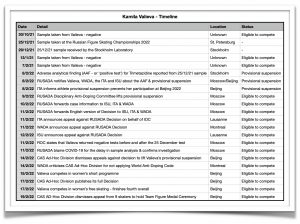
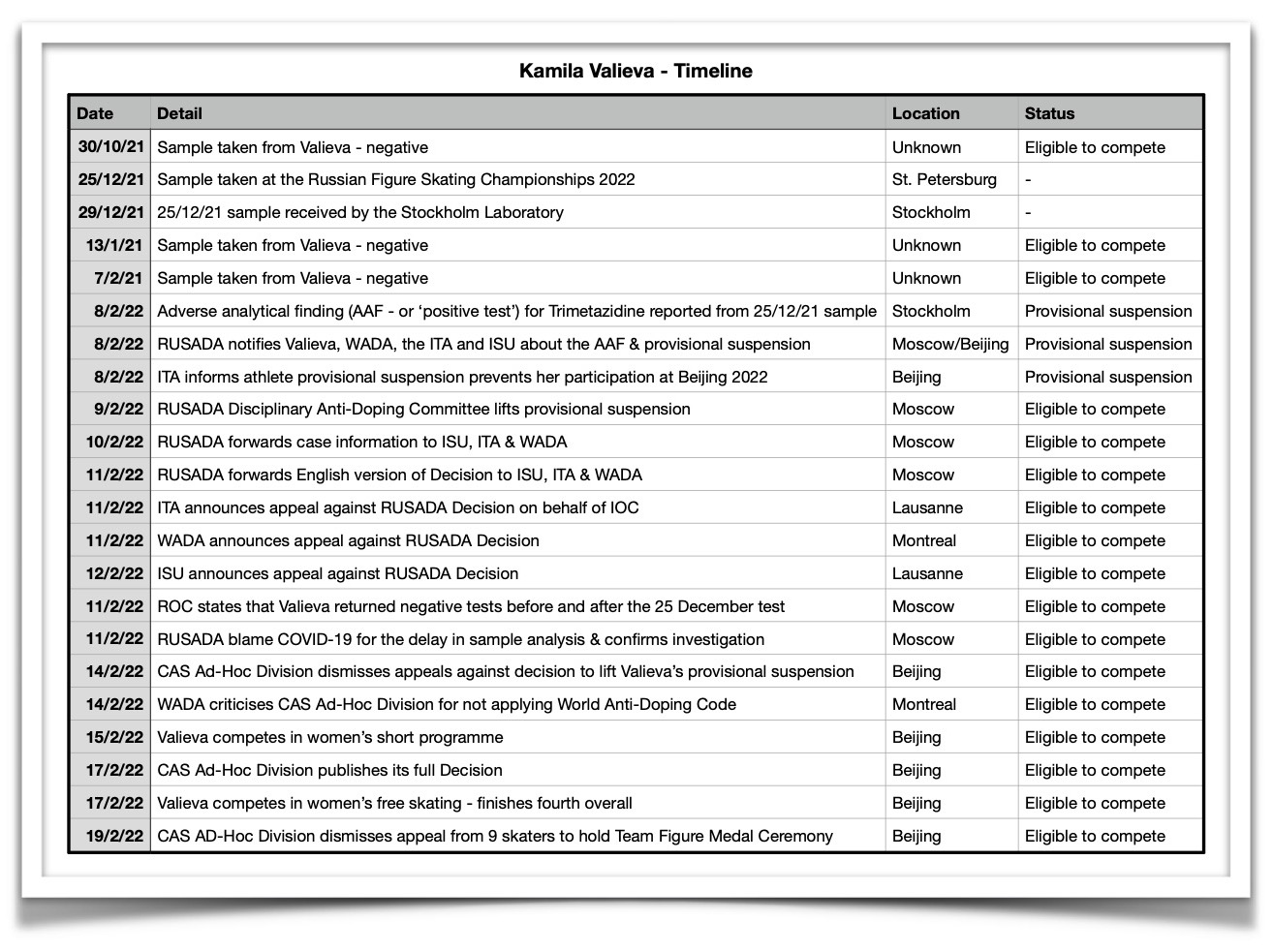
A sample she gave on Christmas Day returned a positive test (or adverse analytical finding – AAF) for Trimetazidine, a prohibited substance. She was notified of her provisional suspension over a month later, on 8 February, whilst in Beijing for the Winter Olympics. A day later, due to her explanation and her status as a minor, her provisional suspension was lifted by the Russian Anti-Doping Agency (RUSADA).
The International Olympic Committee (IOC), World Anti-Doping Agency (WADA), and the International Skating Union (ISU) then appealed to have that provisional suspension reinstated. On Valentine’s Day, the day before Valieva was due to compete in the Women’s figure short skating, the Court of Arbitration for Sport’s (CAS) Ad-Hoc Division dismissed the appeals. Its full Decision, which was criticised by WADA, was published the day before Valieva was due to compete in the Women’s figure free skating.
In scenes that shocked many, including IOC President Thomas Bach, Valieva faltered and finished fourth. It would appear that the pressure got to her.
A full hearing into whether she has committed an anti-doping rule violation (ADRV) has yet to be conducted. All anti-doping samples are split into two ‘A’ and ‘B’ samples. As Valieva’s ‘A’ sample resulted in a positive test for a small amount of Trimetazidine (2.1ng/mL), she has requested analysis of her ‘B’ sample. If results from that are negative, there may be no case to answer. Up until now, the case has merely been about whether a provisional suspension should have been lifted to allow Valieva to compete at the Beijing 2022 Winter Olympics.
Valieva was tested on Christmas Day whilst competing in the Russian Figure Skating Championships in St. Petersburg. She declared three substances on her Doping Control Form (DCF): L-carnitine (made famous by Alberto Salazar and Mo Farah), Supradyn, and Hypoxen. None of those contain Trimetazidine or any other prohibited substances.
Valieva argued that her grandfather has an artificial heart, and his medication contains Trimetazidine. A video was produced showing him with a packet of Trimetazidine MV, but it was argued that Trimetazidine is available via prescription only and no prescription was produced. However, a Google search reveals that Trimetazidine can be bought online, and Valieva only had 48 hours to prepare a defence.

Andrey Zholinskiy (Андрей Жолинский), a ‘medical expert’ called by Valieva’s defence, told the CAS that Trimetazidine is prohibited for use by minors. Zholinskiy is the Director of the Federal and Medical Biological Agency (FMBA) that prepares Russian athletes for international competition. He is also a member of the Scientific Expert Council of the Russian Olympic Committee (ROC), and is considered to be Chief Physician to the Russian Olympic team. Last year, he told Russian media that all anti-doping tests performed at Tokyo 2020 were negative. This is currently accurate, however future analysis could compromise this.
It appears that Trimetazidine may have been given to Russian athletes by the FMBA in the past. In 2018, Nadezhda Sergeeva came to a settlement agreement with the International Bobsleigh and Skeleton Federation (IBSF) over an ADRV involving Trimetazidine at the PyeongChang 2018 Winter Olympics. The Settlement Agreement – a copy of which is held by The Sports Integrity Initiative – reveals that the source of Sergeeva’s AAF was a contaminated supplement. A lawsuit was launched by Sergeeva against the FMBA, which she alleged had given her the supplement leading to her AAF. It was dismissed by the State courts.
As mentioned in the CAS Decision, as a 15 year old Valieva is considered a ‘protected athlete’ under the World Anti-Doping Code. Punishment for those responsible for doping a ‘protected athlete’ are severe. ‘An Article 2.7 or Article 2.8 violation [Trafficking or Administration] involving a Protected Person shall be considered a particularly serious violation and, if committed by Athlete Support Personnel for violations other than for Specified Substances, shall result in lifetime Ineligibility for Athlete Support Personnel’, reads Article 10.3.3 of the Code.
RUSADA and the ROC have announced that they will investigate Valieva’s encourage, which has poured suspicion on her coaching team. Perhaps with good reason, but perhaps not.
Philip Shvetsky (Филипп Шветский) is the Doctor of the Russian figure skating team, as confirmed in the Russian figure skating federation (FSR) magazine. In the Russian media, he has been put forward as a potential culprit for Valieva’s AAF. It is alleged that he was involved with use of prohibited infusions by the Russian rowing team that led to its disqualification from the 2007 World Championships.
His Instagram page (see below) has been cited as proof that he has worked with Valieva. However, his Instagram profile was only launched 17 weeks ago.
View this post on Instagram
It has also been alleged that Valieva’s Coach, Eteri Tutberidze (Этери Тутберидзе), disregards the health of her skaters. However this doesn’t make her a doping facilitator, and her Instagram page appears to indicate that her current skaters are happy with her. The FSR has also refuted suggestions that Valieva’s coaching team was ‘cold’ towards her following her performance.
View this post on Instagram
As mentioned, the FMBA is responsible for preparing Russian athletes for international competition. It bears repeating that Valieva, 15, declared three supplements on her DCF. Who gave her those supplements to take?
Under the anti-doping system, athletes are sanctioned and punished for doping offences. However, anti-doping organisations are also required to investigate. RUSADA would no doubt argue that it is fulfilling this duty by investigating Valieva’s immediate entourage, such as her Coach and Shvetsky, the FSR Doctor.
RUSADA and the ROC haven’t announced an investigation into the FMBA. Perhaps this is why WADA’s Intelligence and Investigations team are looking into Valieva’s case.
Part of the problem is that due to Valieva’s status as a minor, a different assessment of fault is required under the Code. The CAS sums up the difficulties involved with this.
‘Even if [the eventual ADRV assessment] process finds a doping rule violation, the ability to show intention or fault of a minor athlete such as this one might be difficult, and, lacking that intention or fault, the sanction is likely to be on the low end of the range’, reads the Ad-Hoc Decision. ‘Strict application of the rules as written for Provisional Suspensions would almost certainly in every case involving a Protected Minor result in a Provisional Suspension longer than the likely period of actual suspension. This is not satisfactory from a legal point of view.’
However, WADA wasn’t satisfied with the CAS Ad-Hoc Division’s decision to interpret, rather than apply, the Code. ‘It appears that the CAS panel decided not to apply the terms of the Code, which does not allow for specific exceptions to be made in relation to mandatory provisional suspensions for ‘protected persons’, including minors’, reads a statement.

• Why did Graham Arthur, former Director of Legal at UK Anti-Doping (UKAD), represent RUSADA at the CAS Ad-Hoc hearing?
• Why didn’t RUSADA flag Valieva’s sample as priority, given her expected participation in Beijing 2022?
• Given that the Moscow Laboratory is suspended, where were Valieva’s samples on 30 October, 13 January, and 7 February sent, and why were they also not delayed?
• Valieva’s mother said that Valieva was taking supplements for heart problems (see right). Is there medical evidence for this?
• Why did the US and Canadian Olympic Committees request to be ‘silent observers’ in this case (the CAS Ad-Hoc rejected their application)?
• Valieva argued that the CAS Ad-Hoc Division lacked jurisdiction to hear the case and argued against Jeff Benz’s appointment as an Arbitrator due to his previous status as a USOC employee – such arguments appear odd for a 15yr old to make, don’t help her case, and suggest State involvement in her defence.
Towards the end of the week, two high profile cases shifted the spotlight away from Valieva. The Athletics Integrity Unit (AIU) sanctioned Blessing Okagbare of Nigeria with a ten year ban, and the CAS Anti-Doping Division (CAS ADD) confirmed that CJ Ujah committed an anti-doping rule violation (ADRV) at the Tokyo 2020 Olympics, and annulled the Silver medal won by Great Britain’s 4x100m team.
Ujah accepts that he is guilty of an ADRV, but maintains that his positive test was caused by a contaminated supplement (see below). However, irrespective of whether that is accurate his teammates will still lose their medals, as he has committed an ADRV and has potentially benefitted from the use of a prohibited substance. A full hearing on whether a supplement was to blame and if so, what ban should be applied, will be held in due course.
CJ Ujah has released a statement ? pic.twitter.com/hPZkogDeMN
— Sky Sports News (@SkySportsNews) February 18, 2022
Okagbare was sanctioned after two samples she gave outside of competition ahead of Tokyo 2020 returned an AAF for human growth hormone (HGH) and erythropoietin (EPO). The AIU Decision reveals that resulted in a five year ban; an additional five years was added due to Okagbare’s refusal to cooperate with the AIU’s investigation.
On 15 September 2021, the AIU ordered Okagbare to provide access to all her electronic communications devices, including her mobile phone. Okagbare refused, however the full Decision reveals that the US Federal Bureau of Investigation (FBI) imaged her phone as part of its investigation into Eric Lira.
In January, the naturopathic therapist became the first person to be successfully charged under the US Rodchenkov Anti-Doping Act (RADA). The AIU Decision outlines that it is ‘comfortably satisfied’ that Okagbare is ‘Athlete 1’ outlined in the FBI’s investigation – perhaps for the reasons we outlined in January. The Decision outlines that Okagbare denies that she is ‘Athlete 1’.
‘The AIU is thankful to USADA, the FBI and the US Attorney’s Office for their contribution to the integrity of our sport’, reads a statement. Perhaps similar assistance under criminal legislation would also help anti-doping authorities get to the bottom of the Valieva case.
Okagbare has 30 days in which to appeal the Decision to the CAS – i.e. until 30 March. She has indicated that an appeal is likely (see below).
My attention has been drawn to the statement issued by the AIU regarding its disciplinary panel decision. My lawyers are currently studying it for our next line of action which we will inform you soon.????❤
— Blessing Okagbare MFR (@mountain214) February 18, 2022
Like Ujah, Cyclist Toon Aerts and Cross Country Skier Valentyna Kaminska deny that they are at fault for AAFs reported during the last week. Aerts said he had never heard of breast cancer medication Letrozole, and confirmed he would seek analysis of his B sample (see below). Kaminska denied taking three prohibited substances, but outlined that she won’t be able to gather evidence to prove this (see below).
— Aerts Toon (@ToAerts) February 15, 2022
View this post on Instagram
Please continue to send any cases we may have missed or suggestions through to our editor by clicking here. Also, if you’re an athlete, national anti-doping organisation (NADO) or other Results Management Authority and you’d like us to cover a case that you’re involved with, please get in touch! Also – a reminder. The SII Anti-Doping Monitor only features confirmed AAFs (‘positive tests’) or confirmed anti-doping rule violations (ADRVs).
Elizaveta Koklina (statement, Decision, previous sanction);
Timur Mukhtarulin (statement, Decision, previous sanction);
Fernanda Martins (statement, Decision);
Kamila Valieva (CAS Ad-Hoc Division statement, WADA statement, ROC statement, FSR statement, RUSADA statement,; CAS Ad-Hoc Division Decision);
Blessing Okagbare (AIU statement, AIU Decision; Eric Lira charge sheet);
Chijindu Ujah (CAS Anti-Doping Division statement; British Olympic Association statement).
• Eleven athletes (and a horse trainer) from eleven countries, competing in nine sports, were...
• 20 athletes from nine countries, competing in ten sports, were involved in anti-doping proceedings...
• Twenty four athletes from 13 countries, competing in eight sports, were involved in anti-doping...