





The trouble with Ostarine: Jimmy Wallhead’s
16th March 2018
Features



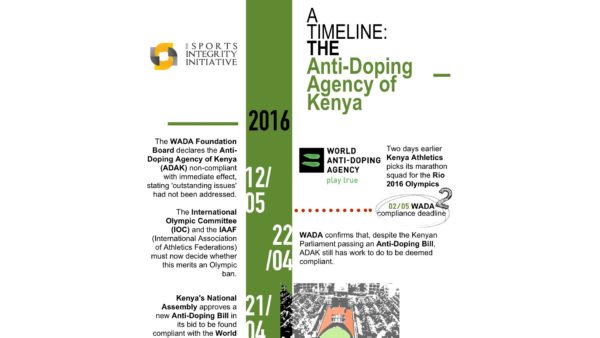
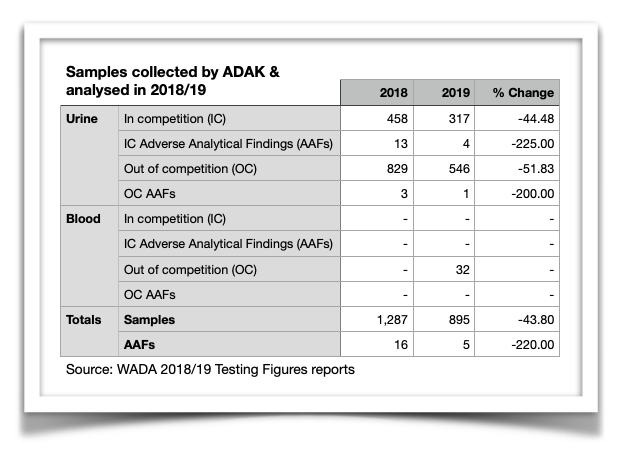 The number of samples analysed due to tests commissioned by the Anti-Doping Agency of Kenya (ADAK) fell by 30% from 1,287 during 2018 to 895 during 2019, according to reports published by the World Anti-Doping Agency (WADA). ADAK placed 46th out of 117 national anti-doping organisations (NADOs) in a 2019 table ranked by samples analysed, despite Kenya having a population of over 50 million. Cuba’s NADO ranked higher, despite the country having a population of just eleven million.
However, ADAK is not alone in commissioning analysis of few athlete tests. The Egyptian national anti-doping agency (EGY-NADO) reported analysis of just 895 samples, despite having a population more than double Kenya’s. Nigeria’s NADO (NADC) commissioned analysis of just 315 samples in 2019, despite the country having a population more than double Egypt’s (four times Kenya’s).
However, neither of those countries reported as dramatic a change as Kenya when compared to 2018’s testing figures. However, Kenya’s figures are also more significant than Egypt or Nigeria’s due to the success of its distance runners, which has inspired a number of elite athletes to train in its remote mountain areas.
Almost all (34 out of 38) of the sanctions published on ADAK’s internet site involve athletics. Out of the 495 suspended athletes that feature on the Global List of Ineligible Persons published by the Athletics Integrity Unit (AIU) of World Athletics, 58 (12%) are Kenyan.
Eldoret in the Kapsabet region is around 2,100 metres above sea level, and is a gateway city for high altitude training in the surrounding towns and villages. Over a sustained period, altitude training is thought to benefit athletes, as lower oxygen levels means that the body increases red blood cell and haemoglobin production to compensate. This aids the blood in carrying oxygen to the muscles, a benefit that remains for 10-14 days after the athlete returns to a lower altitude.
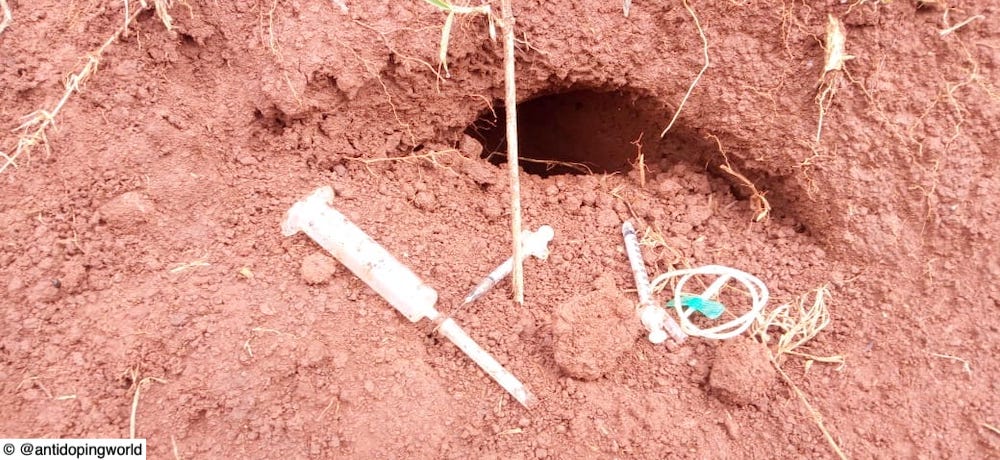 As mentioned, due to the success of Kenyan runners and because of the above, many elite athletes train in Kenya’s high altitude regions. In September 2019, it was discovered that pharmacists in Eldoret were continuing to supply athletes with erythropoietin (EPO), seven years after the issue was originally uncovered. In April this year, police launched an investigation after Anti-Doping World published photos (see right) of used syringes it claimed were taken at the Kamariny Stadium in Iten, around 40km from Eldoret.
Iten is also the location of the High Altitude Training Centre (HATC), where in 2016 investigative journalists found packets of EPO and syringes in the bins. A video featured a pacesetter who used to work for the HATC arranging to buy EPO from a pharmacist in Eldoret.
Earlier this year, ADAK posted a terse response after a news article suggested that it was ineffective in tackling doping in Kenya. The statement pointed out that it had successfully prosecuted 147 anti-doping rule violations (ADRVs) since its formation in 2016, and five cases were pending before Kenya’s criminal courts.
Given the allegations regarding blood doping, it is perhaps surprising that in 2018, ADAK commissioned no blood tests, and just 32 out of competition blood tests in 2019 (none of which returned an adverse analytical finding – AAF). ADAK recorded just five AAFs in 2019, down from 16 in 2018. It is not known how many of these resulted in an anti-doping rule violation (ADRV), as AAFs – or ‘positive tests’.
However, testing doesn’t catch large numbers of doping cheats – investigations do. WADA’s 2019 testing figures revealed that just 0.97% of the 278,047 samples analysed during the year resulted in 2,702 AAFs. Not all of these AAFs will result in ADRVs being asserted against athletes. Some will be explained via therapeutic use exemptions (TUEs) and in others, the athlete may be judged not to be at fault for the AAF.
From conversations with anti-doping organisations, it is understood that approximately 10% to 20% of AAFs are ‘accidental’, due to contaminated food or supplements. So a high number of AAFs doesn’t necessarily mean that a NADO is catching doping cheats. It just means that prohibited substances are being found in athlete samples. Testing doesn’t catch a clever cheat.
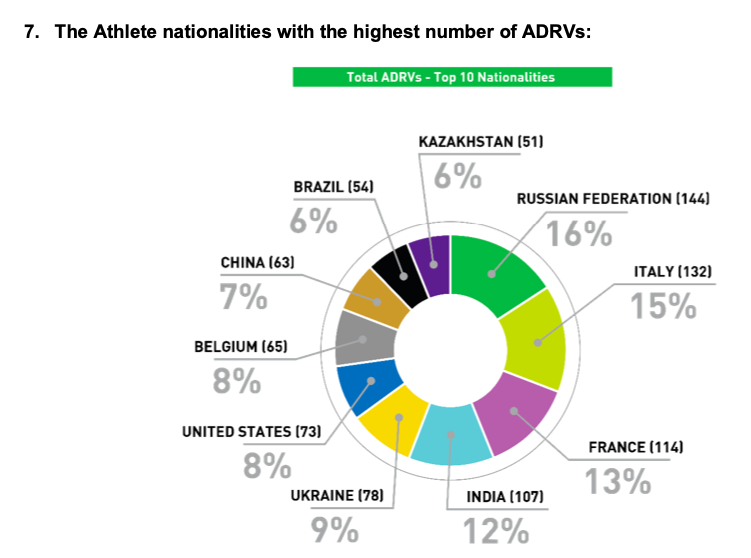
As such, it is good news that Russian athletes topped WADA’s 2018 ADRV Report. It means that athletes are being tested, substances are being detected, and ADRVs are being asserted against them. This is preferable to the reverse scenario. During the Sochi 2014 Winter Olympics, Russia didn’t report a single AAF, yet a State orchestrated doping programme was later discovered, via an investigation.
Anti-doping tests are expensive. As such, ADAK shouldn’t be criticised for a drop in testing numbers and AAFs. It doesn’t mean that it isn’t doing its job properly. It may be the case that politicians have decided that there are more pertinent issues that require funding ahead of anti-doping.
The Sports Integrity Initiative has chosen to focus on Kenya because it is suspected that doping takes place in remote Kenyan locations, yet few tests are conducted in comparison to other nations. It is a good example of how WADA’s testing figures can reveal gaps in the anti-doping testing system that need to be filled.
• Eleven athletes (and a horse trainer) from eleven countries, competing in nine sports, were...
• 20 athletes from nine countries, competing in ten sports, were involved in anti-doping proceedings...
• Twenty four athletes from 13 countries, competing in eight sports, were involved in anti-doping...