
The trouble with Ostarine: Jimmy Wallhead’s
16th March 2018
Features

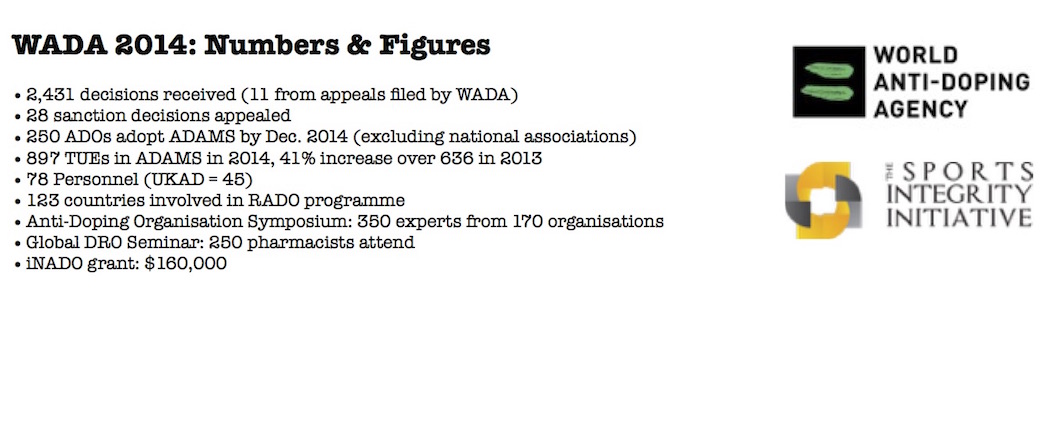
The World Anti-Doping Agency (WADA) has called for an increase in funding, after it reported an increase in net losses from US$151,000 for the year to 31 December 2013 to US$1.14 million for 2014. ‘As cash reserves deplete, it is imperative to increase funding and seek solutions to decrease expenditures without reducing WADA’s core activities’, read its annual report, published on 20 July.
WADA’s operating expenses only increased marginally over 2013 – up 1% to $29.7 million in 2014, however its total income only increased by 0.5% to $29.3 million. This was largely due to a reduction in grant income due to Montreal International extending its agreement with WADA for another ten years, and due to reductions in grant income from the governments of Australia and Japan.
WADA said that the increased net loss was due to an exchange rate impact, whereby the translation of cash and cash equivalents resulted in a loss on exchange of $951,945. ‘The loss on exchange is a non-cash item, and does not impact WADA’s cash flow’, read the report. In 2009, the WADA Foundation Board agreed to a reserve of $2.4 million dedicated to operations – it also has a reserve of $1.5 million, agreed in 2007, designed to cover litigation costs. The report did not reveal how much of the 2009 reserve remains, but it did concede that the $1.14 million loss was ’28% higher than the budgeted deficit’.
WADA had previously warned that unless further funding is found, it would have to cut back on activities, and the 2014 shows signs that this is happening. The amount that WADA spent on travel & accommodation, research grants, education and project consulting fees showed significant spending decreases, as our table shows. These cuts are set to continue into 2015, with WADA planning ‘substantial’ decreases in research grants and travel costs. ‘Once again, the Executive Committee and Foundation Board will meet their air travel costs in attending 2015 meetings’, read the report. WADA received its public sector contributions from all regions of the world apart from Africa, which only made up a small percentage of the total.
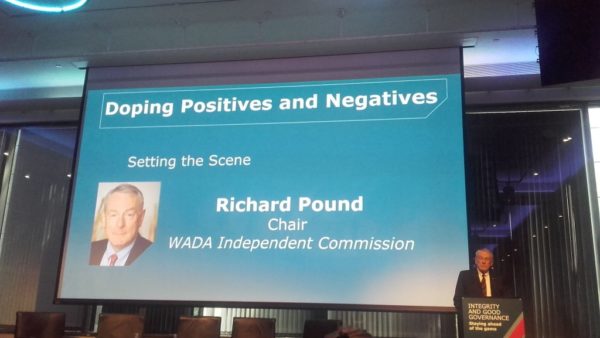
However, a special anti-doping research fund has been established by WADA and the International Olympic Committee (IOC), which agreed to match any amount invested in the fund by governments. This is expected to provide an additional $12 million for anti-doping research by 31 March 2016. WADA also said that the three person independent commission it established to investigate various allegations of doping made through German television documentaries would complete its work ‘by the end of 2015’. The commission is headed by former WADA President Dick Pound, and was appointed in December 2014.
• Eleven athletes (and a horse trainer) from eleven countries, competing in nine sports, were...
• 20 athletes from nine countries, competing in ten sports, were involved in anti-doping proceedings...
• Twenty four athletes from 13 countries, competing in eight sports, were involved in anti-doping...