


The trouble with Ostarine: Jimmy Wallhead’s
16th March 2018
Features

Ten athletes from five countries, competing in nine sports, were involved in anti-doping proceedings that came to light this week. Despite the involvement of some relatively high profile names, proceedings didn’t grab the media’s attention as they did last week. However, that doesn’t make the cases any less interesting.
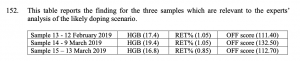
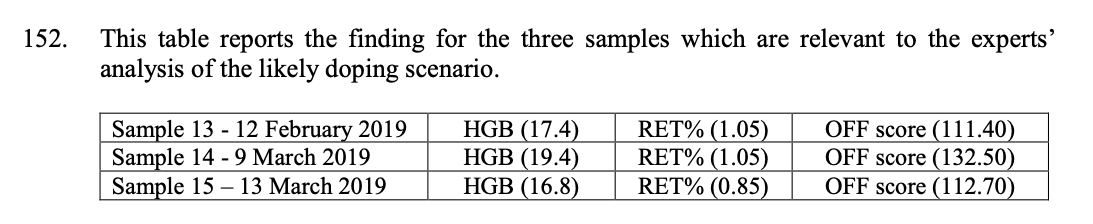
Can a single blood value, which is so ‘extraordinarily high’ that it represents a danger to an athlete’s health through thrombosis, indicate blood doping? Even when a ‘B’ sample exists but hasn’t been analysed? Even when blood values return to near normal four days later? Even when an ‘Expert Panel conceded that there are no known cases of transfusion doping in Kenya’, as the Court of Arbitration for Sport (CAS) wrote?
As the Daniel Kinyua Wanjru Decision indicates, World Athletics contends that blood doping is more likely than sample analysis errors, and the CAS agrees. Scientists on both sides agreed that the ‘aberrantly high value’ measured for haemoglobin, returning to normal values four days later was a ‘rare anomaly’. World Athletics didn’t disagree with the 2017 London Marathon winner’s contention that values of this magnitude are ‘highly unexpected’.
On 11 March 2019, two blood tubes were received by the King’s College Laboratory in London, but only one was analysed, and this gave rise to the abnormal value. World Athletics argued that although collection of a second tube of blood is recommended, its analysis isn’t required under the World Anti-Doping Code and applicable international standards.
‘Even assuming that the failure to analyse the second sample was somehow a departure from proper procedure, the Athlete has not demonstrated how such a departure caused or could have caused the abnormal HGB result’, argued World Athletics. The CAS agreed with its assessment. It isn’t known what happened to the second tube of blood.
The CAS stressed that the burden of proof was on World Athletics. ‘To be clear: the Athlete bears no burden of proof’, reads the Decision. ‘The burden of proof in this case lies entirely on WA, to the standard of comfortable satisfaction. To counter the laboratory finding and the inference of blood-doping, the Athlete need only sow sufficient doubt in the minds of the Panel so that it is not comfortably satisfied that there was an ADRV.’
Wanjru provided details of his movements from 7-9 March 2019. However despite the above statement, the CAS Panel found that ‘the Athlete’s asserted itinerary has some holes in it that cannot be verified and are not supported by evidence presented to the Panel for the hearing, notably in the morning of 7 March 2019 and the afternoon of 8 March 2019. On their face, the time stamps on his tendered police report, flight itinerary and messages sending photographs appear to leave limited opportunity for him to have received a transfusion of significant volume, which would have required some hours. But in the end the Athlete’s account is objectively self- serving and cannot be taken at face value to invalidate the high probability of doping’.
The CAS didn’t accept the explanations of Wanjru and concluded that blood doping was the most likely explanation. The case illustrates the difficulty that athletes have in refuting doping charges, even when CAS agrees that the burden of proof is on sport, rather than the athlete. There were holes in both sides of the argument – what happened to the second blood tube?
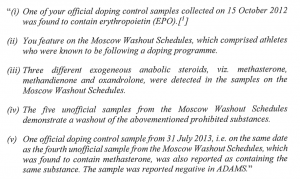
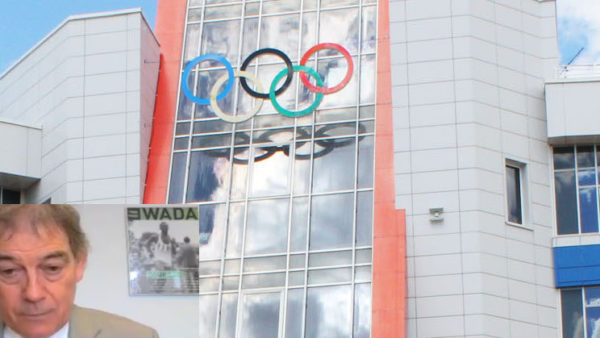
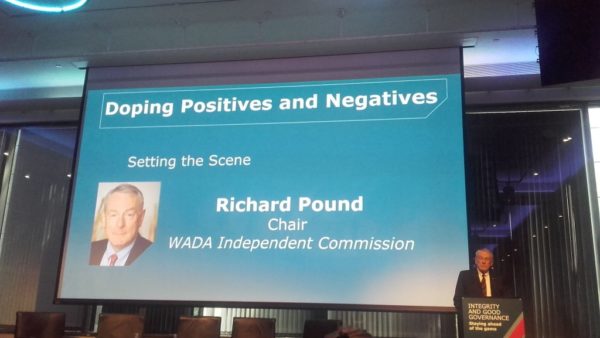
In one of the longest-running doping cases in sport, Russian high jumper Alexander Shustov (Александр Шустов) has appealed a CAS Decision to dismiss his appeal against a four year ban to the Swiss Federal Tribunal. The case is important for both sides as there is no positive sample (adverse analytical finding – AAF) involved. Shustov was banned purely based on evidence in the Reports produced by Richard McLaren for the World Anti-Doping Agency (WADA), which suggested that he was part of Russia’s State doping programme (see right).
Murad Rabadanov (Мурада Рабаданова), who won Silver in the 2021 Russian Boxing Championships, has been sanctioned with a six year ban for use or attempted use of prohibited substances. The Russian Anti-Doping Agency (RUSADA) didn’t announce further details regarding the case.
A figure skater who, in contrast to Russian 15 year old Kamila Valieva (Камила Валиева), actually returned a positive test (AAF) at the Beijing 2022 Winter Olympics, has been provisionally suspended. Spaniard Laura Barquero Jiménez returned an AAF for Clostebol, a steroid often used in dermatological creams and nutritional supplements.
The Valieva saga rumbles on. Oleg Matytsin (Олег Матыцин), Russia’s Minister of Sport, appeared to defend her coaching team in an interview with Russian State media, which ensured that the focus remains on them and not on the Federal and Medical Biological Agency (FMBA), which is in charge of preparing Russian athletes for international competition.
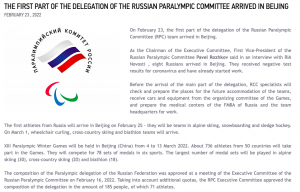 Valieva returned an AAF for Trimetazidine and as reported last week, supplements containing the anti-angina drug have been given to athletes by the FMBA in the past. Valieva listed three supplements on her doping control form (DCF). Who gave her those supplements? Meanwhile, the FMBA has arrived in Beijing to prepare Russia’s Paralympians for their Winter Olympics (see right).
Eteri Tutberidze (Этери Тутберидзе), Valieva’s Coach, defended her handling of Valieva at the Beijing Olympics, which was widely criticised. ‘The test that fell to Kamila, our whole team needs to go through together’, she wrote in a cryptic social media post (below). ‘How indicative are such situations – those who were smiling yesterday, today left the stands, defiantly ignored and attacked like jackals, offering different methods of inquisition. So much the better that fate takes these people away from us, exposing the truth.’
View this post on Instagram
Another athlete who returned an AAF at Beijing 2022 has taken the Decision to retire. ‘Skiing is over for me’, wrote Hossein Saveh Shemshaki, who reported an AAF for DHCMT at Beijing 2022. ‘There is a problem, he took supplements, I had a sore foot. In short, we pick so many cobras and accuse everyone as the reason for our failures as we are the perfect person […] If, in this incident I was to blame, I will apologise and pay the ransom. But if not…’
View this post on Instagram
Italian Serie B footballer Orji Okwonkwo has also been provisionally suspended after returning an AAF for an unnamed prohibited substance. Please continue to send any cases we may have missed or suggestions through to our editor by clicking here. Also, if you’re an athlete, national anti-doping organisation (NADO) or other Results Management Authority and you’d like us to cover a case that you’re involved with, please get in touch! Also – a reminder. The SII Anti-Doping Monitor only features confirmed AAFs (‘positive tests’) or confirmed anti-doping rule violations (ADRVs).
Aleksandr Shustov (CAS Decision & background);
• Eleven athletes (and a horse trainer) from eleven countries, competing in nine sports, were...
• 20 athletes from nine countries, competing in ten sports, were involved in anti-doping proceedings...
• Twenty four athletes from 13 countries, competing in eight sports, were involved in anti-doping...