


The trouble with Ostarine: Jimmy Wallhead’s
16th March 2018
Features

The announcement of 14 anti-doping rule violations (ADRVs) by the Russian Anti-Doping Agency (RUSADA) made an otherwise quiet week in anti-doping jurisprudence into a busy one – albeit with some very interesting cases. A total of 23 athletes from four countries, competing in 14 sports, were involved in anti-doping procedures that came to light this week.
Six of the 14 anti-doping rule violations (ADRVs) announced by RUSADA involved Powerlifting and included a ten year ban issued to a powerlifter and coach for tampering or falsification of doping controls. RUSADA pursues a policy of not announcing what substances are involved when publicising ADRVs, perhaps to avoid advertising which substances athletes have been using.
However, the Russian Powerlifting Federation is not so coy. It published a letter (PDF below) from Russia’s Ministry of Sports quoting research from a subsidiary of the Federal, Medical and Biological Agency (FMBA) about the abuse of Epokrin in sport.
The notice is published by ‘Gos.NII OCHB (Гос.НИИ ОЧБ)’, a subdivision of the FMBA, which also holds the licensing certificate for Epokrin. ‘In connection with the identified increase in the use of erythropoietin preparations (without indicating trade names) as a doping agent, the Federal State Unitary Enterprise ‘Gos.NII OCHB’ informs that the drug Epokrin® solution for intravenous and subcutaneous injection (1,000IU/mL; 2,000IU/mL; 4,000IU/mL; 10,000IU/mL) should be applied strictly in accordance with instructions fo medical use’.
In other words, the Russian Ministry of Sport has forwarded a letter from a subsidiary of the FMBA warning about the abuse of a form of EPO that contains instructions on how to use it to Russia’s sporting federations. The FMBA is the licence holder for that drug, and is also in charge of preparing Russian athletes for international competition. And the Russian Powerlifting Federation has advertised that information to all Russian Powerlifters via its internet site.
Epokrin isn’t a new drug. It was listed on page 89/90 of the first Independent Commission Report into Russian State doping produced by the World Anti-Doping Agency (WADA) as one of 19 drugs that ‘are in common use and […] occur in recorded conversations’. One might question why the Ministry of Sport issued its notice now?
It is generally accepted that EPO takes between one and two months to work (longer for microdosing). The letter states that the Gos.NII OCHB advised the Ministry of Sports about its research on 11 August last year, and the Ministry of Sport sent its letter on 21 September. The Beijing 2022 Winter Olympics began on Friday.
The Ministry of Sport would no doubt argue that the timing of its letter was designed to warn sporting federations about the potential use of Epokrin, so that Russian athletes don’t return adverse analytical findings (AAFs – or ‘positive tests’) ahead of the Games. If that is the case, why include the recommended medical dosage? And why publicise the letter?
The Ministry of Sport was certainly keen to get the information across. ‘We ask you to take timely measures to being this information to the attention of athletes, coaches, other personnel, as well as organisations providing sports training, and organisations providing medical and biomedical support to athletes on the territory of the Russian Federation’, reads its introduction. ‘Application: for seven litres in one dose’.

Russia has a history with intravenous infusions. It appears that the Russian State interfered in an investigation by RUSADA into their use on youth athletes in the Chuvash Republic. Yuriy Ganus’s (Ю́рий Га́нус) attempts to get to the bottom of what was going on is understood to have contributed to his dismissal as RUSADA’s Director General in August 2020.
RUSADA also announced that a four year ban was issued to Konstantin Panov (Константина Панова), a Russian ice hockey player. It has yet to be confirmed if this is the same Konstantin Panov that coaches Traktor Chelyabinsk, who is understood to still compete in veteran competitions.
Across the pond, USADA amended a statement issued regarding a sanction issued to Eliud Ngetich of Eldoret, Kenya. Last year, it was announced that Ngetich had been sanctioned with a one year ban for a 2014 ADRV involving nandrolone, which was reduced from the two year standard ban applicable under the 2009 World Anti-Doping Code due to substantial assistance provided to USADA. That part of the statement was apparently correct.
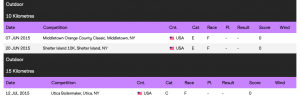
USADA said that the statement incorrectly stated that Ngetich was provisionally suspended for four months from 28 March until 27 July 2015. However, he competed in three events in June and July 2015 (see right). This page indicates that Ngetich competed in six events in the 28 March to 27 July 2015 period, earning US$10,900 for his efforts.
An amended statement was issued this week, clarifying that his provisional suspension actually ran from two months from 28 March to 27 May. USADA also said there was a second mistake in last year’s statement. It apparently incorrectly stated that Ngetich served an eight month ban from 19 August 2021. The 2022 statement indicates a ten month ban from 19 August 2021.
In another US case, Bernabe Chavez was sanctioned with a four year ban for lending his weightlifting Coaching credentials to Ernst Prempeh, who was caught Coaching an athlete at the US Weightlifting Championships in July last year. Prempeh had been sanctioned with a four year ban in 2019 due to an ADRV involving steroids, and his ban didn’t expire until 7 December this year. It will now expire on 7 December 2026.
In South Australia, jockey Jason Holder was perhaps lucky to escape with a five month ban, given that he tested positive for a prohibited substance and was found guilty of sample substitution. A first sample provided on 9 December 2021 was found to be a substitute sample, and a second sample returned an AAF for a prohibited substance.
Given his ‘personal circumstances’, Racing South Australia decided that his two month ban for substituting his sample should run concurrently with his five month ban for an ADRV involving a prohibited substance. As such, he is banned from 27 January to 27 June this year.
Finally, Cycling Weekly reports that WADA will investigate traces of Tizanidine found in the hair of cyclists at last year’s Tour de France. Scientists from the University of Strasbourg, engaged by French Police, found the muscle relaxant, sold under the trade names Sirdalud or Zanaflex, in hair samples taken from ‘international racing cyclists’, reports a September 2021 Study. Tizanidine doesn’t feature on WADA’s Prohibited List. It is understood that French police found boxes of Tizanidine in the hotel room of a team Doctor. Team Bahrain Victorious, who were targeted by Police during last year’s Tour, clarified that they were not notified about the situation.
Please continue to send any cases we may have missed or suggestions through to our editor by clicking here. Also, if you’re an athlete, national anti-doping organisation (NADO) or other Results Management Authority and you’d like us to cover a case that you’re involved with, please get in touch! Also – a reminder. The SII Anti-Doping Monitor only features confirmed AAFs (‘positive tests’) or confirmed anti-doping rule violations (ADRVs).
Eliud Ngetich (amended sanction & original sanction);
Ernest Prempeh & Bernade Chavez (sanction & Prempeh’s original sanction)
• Eleven athletes (and a horse trainer) from eleven countries, competing in nine sports, were...
• 20 athletes from nine countries, competing in ten sports, were involved in anti-doping proceedings...
• Twenty four athletes from 13 countries, competing in eight sports, were involved in anti-doping...