

The trouble with Ostarine: Jimmy Wallhead’s
16th March 2018
Features


Eleven athletes from seven countries, competing in five sports, were involved in anti-doping proceedings that came to light this week. Two cases involved detection of prohibited substances from reanalysis of samples taken almost ten years ago, and another involved a ban issued to a retired player following reanalysis of a sample taken eight years ago.

“We keep many samples from a variety of sports in our long-term storage facility, and regularly conduct this type of analysis”, said Pat Myhill, CEO of UK Anti-Doping (UKAD), when announcing a two year ban issued to retired Leigh Centurions player Jamie Acton. However, Acton’s sample was one of only 22 rugby league samples retested by UKAD in the nine years to 21 January 2020.

Amazingly, UKAD didn’t retest a single sample from a footballer during this period. This is despite 2016 claims by Dr. Mark Bonar to have provided ‘treatment’ to Arsenal, Birmingham City, Chelsea, and Leicester City players, as well as cricketers, boxers, and tennis players. Perhaps unsurprisingly, Acton’s positive test was UKAD’s first result from reanalysis of a sample placed into storage.
Acton says he spoke out about his personal drug problems, as well as drug problems in rugby league, in a video posted last year. Also unsurprisingly, UKAD then ordered reanalysis of a sample he gave in 2014.
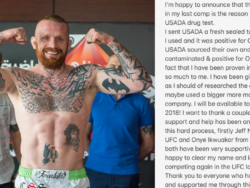
‘Basically, following a video I posted last year highlighting my personal drug problem and the massive drugs problem in rugby league, COINCIDENTALLY my old samples were retested using new technology and a sample from 2015 has been flagged as positive for GHRP6 so I’m being banned for 2 years’, he wrote in a statement on Instagram (below). ‘Not that relevant when you’re already 3 years retired, but I think it’s a big problem that the RFL [Rugby Football League] wish to silence those raising awareness about the drug problems within the sport, rather than encourage such discussions which I believe could potentially really help current and future players’.
View this post on Instagram
In other anti-doping news Rakhi Halder, Gold Medal winner in the 64kg category at the 2019 Commonwealth Games Weightlifting Championships, has been sanctioned with a four year ban expiring on 5 March 2025. Halder returned an adverse analytical finding (AAF – or ‘positive test’) for a metabolite of exogenous testosterone (Eticholanolone) from a November 2020 out of competition test.
Bernard Sainz, often known by the ‘Dr. Mabuse’ monicker, was sentenced to one year’s house arrest, reports L’Equipe. It is understood that he was prosecuted for repeated acts of ‘illegal practice of medicine and pharmacy’ and for ‘aiding or inciting the use of prohibited substances and/or methods within the framework of a sporting event’ between 2013 and 2017. Like Eric Lira, who last week became the first person to be charged under the Rodchenkov Anti-Doping Act (RADA), Sainz describes himself as a ‘naturopath’.
Italy’s national anti-doping agency (NADO Italia) will investigate allegations that caused Marcel Jacobs to split from his nutritionist prior to winning Gold in the Tokyo 2020 100m, reports The Times. Assisting an athlete to dope is a criminal offence in Italy. Earlier this week charges against Giacomo Spazzini, the former bodybuilder who claimed to have masterminded Jacobs’ success, were dropped by Italian police. However Antonio Armiento, who worked at Spazzini’s clinic, was convicted of falsely claiming to be a Doctor.
The above cases again illustrate how criminalising doping can assist in convicting those that supply and assist with doping. In Acton’s case, a criminal investigation might have established whether he was acting alone, or whether rugby league has a deeper problem with doping. Anti-doping testing and jurisprudence often only punishes an athlete who fails a test. Criminal legislation punishes the team that assisted them.
Please continue to send any cases we may have missed or suggestions through to our editor by clicking here. Also, if you’re an athlete, national anti-doping organisation (NADO) or other Results Management Authority and you’d like us to cover a case that you’re involved with, please get in touch! Also – a reminder. The SII Anti-Doping Monitor only features confirmed AAFs (‘positive tests’) or confirmed anti-doping rule violations (ADRVs).
Rakhi Halder, Vishvendra Singh, Jasdeep Singh, and Vivek Bharat Nayakal;
Aslan Bideev and Andrey Kozlov;
• Eleven athletes (and a horse trainer) from eleven countries, competing in nine sports, were...
• 20 athletes from nine countries, competing in ten sports, were involved in anti-doping proceedings...
• Twenty four athletes from 13 countries, competing in eight sports, were involved in anti-doping...