


The trouble with Ostarine: Jimmy Wallhead’s
16th March 2018
Features

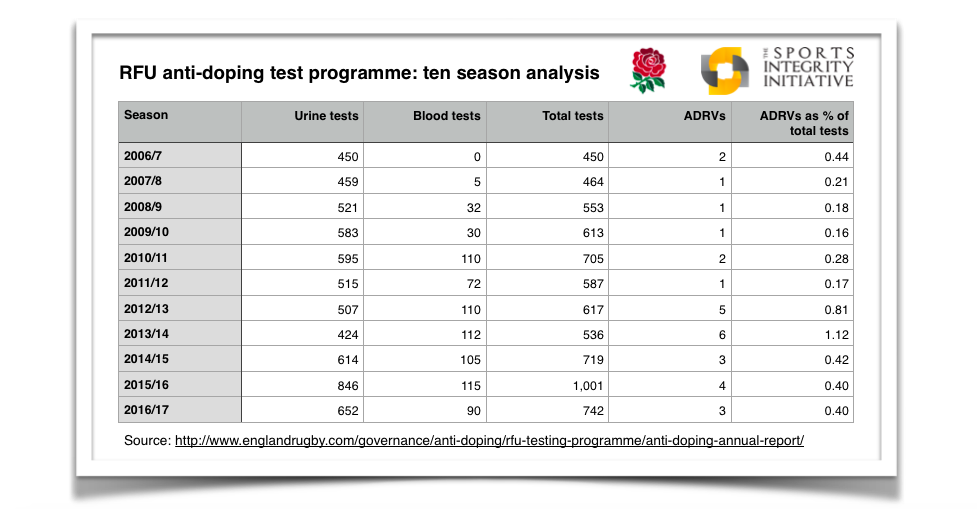
England’s Rugby Football Union (RFU) has said that a 25.9% decline in anti-doping tests from the 1,001 conducted during the 2015/16 season to the 742 conducted during the 2016/17 season is due to the international calendar. ‘The slight reduction in total samples collected was expected and is due largely to an increase in specific testing activity that occurred in the build up to (and during) the 2015 Rugby World Cup and the 2016 Rio Olympics’, reads the RFU’s Anti-Doping & Illicit Drugs Programme 2016/17 Annual Report (PDF below).
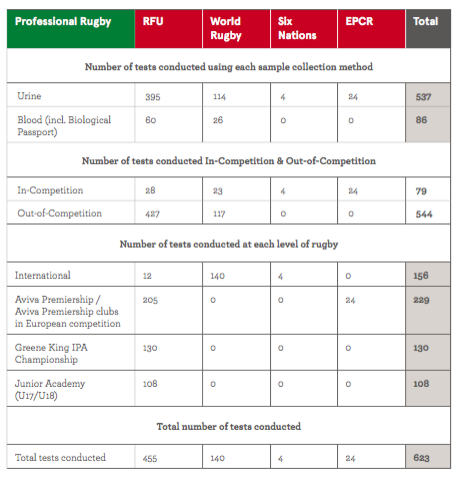 The RFU’s Report showed a 5% decline in the number of tests conducted in the Aviva Premiership, from 241 during 2005/16 to 229 during the 2016/17 season. There were no anti-doping rule violations (ADRVs) from the 623 tests conducted in professional rugby during the 2016/17 season. All four ADRVs recorded by the RFU (one of which is still in progress) involved players from community rugby, representing 3.36% of the 119 tests conducted at that level of the game (below Greene King IPA Championship and Junior Academy level).
One unnamed professional player did test positive for cocaine under the RFU’s separate Illicit Drugs Programme. The reason this was not recorded as an ADRV is because the RFU’s Illicit Drugs programme is not accredited by the World Anti-Doping Agency (WADA) and does not form part of its WADA-accredited anti-doping programme. It is understood that hair testing is not as reliable as blood or urine testing in terms of definitive proof of use, but it does lengthen the detection window, in some cases by up to five months.
 As such, the RFU maintains confidentiality for a first offence, where a player is fined. A second violation of the policy involves loss of confidentiality and a period of ineligibility set by an RFU Disciplinary Panel. ‘There have been no second violations of the policy to date’, reads the Report.
The number of illicit drug tests undertaken on Aviva Premiership players was 302 during the 2016/17 season, 95% of which involved hair testing. This represented a decline from the 386 tests conducted during 2015/16, however the RFU Report said that this was due to ‘amendments made to hair testing procedures following a consultation between the RFU, the RPA [Rugby Players Association] and Alere Toxicology’, its illicit drugs testing partner. ‘It is anticipated testing numbers will return to previous levels in the current season’.
 The RFU has admitted that it is possible that an Aviva Premiership player could go a whole season without being tested, but insisted that if that happened, the player would be flagged for testing by UK Anti-Doping (UKAD). “If a player did go a season without being tested, we flag it with UK Anti-Doping and we make sure we pick those players up”, Stephen Watkins, the RFU’s Anti-Doping and Illicit Drugs Programme Manager told the BBC. It is understood that other high profile sports use a similar approach.
The Daily Mail reported that just 16 match day tests had been carried out on Aviva Premiership players during the 2016/17 season. It is understood that these figures represent the tests that UKAD carried out on Aviva Premiership players. The RFU Report did not offer a breakdown of how many tests on Aviva Premiership players had been conducted in competition and how many had been conducted out of competition.
However, of the 623 tests carried out in professional rugby, 87% were conducted out of competition. If the same percentage is true for the 229 tests carried out on Aviva Premiership players, then 30 in competition tests would have been carried out on Aviva Premiership players during 2016/17, and 199 out of competition tests.
This would mean that in total, 46 in competition tests were carried out on Aviva Premiership players during the 2016/17 season. Although unannounced out of competition tests are understood to be more effective in detecting doping, one of the principles of anti-doping is post competition testing, so that competitors can be sure that those who win a race or match are clean.
The RFU also revealed concerns over use of supplements at schoolboy level rugby union. Research conducted in 2013 in partnership with Leeds Beckett University revealed that supplement use amongst schoolboy rugby union players is ‘prevalent’, and use of prohibited substances is ‘a serious issue in school that needs attention’.
“We remain committed to doing all that we can to protect the integrity and values of our game”, said Watkins in a statement. “The latest findings from our joint research project with Leeds Beckett University shows a lack of awareness in age-grade players, particularly around the use of supplements, raising the risk of vulnerability to doping. This, and wider concerns about low awareness around doping and its impact, led us to develop a strategy for anti-doping in the community game. This will be introduced during the 2017/18 season and will see us increase our focus on improving awareness, enhancing education and increasing testing within the community game.”
• Eleven athletes (and a horse trainer) from eleven countries, competing in nine sports, were...
• 20 athletes from nine countries, competing in ten sports, were involved in anti-doping proceedings...
• Twenty four athletes from 13 countries, competing in eight sports, were involved in anti-doping...