





The trouble with Ostarine: Jimmy Wallhead’s
16th March 2018
Features



Sexual violence in sport is more prevalent than it is in ordinary society, and sporting bodies need to do more to encourage victims to come forward and recognise that their sport may also be involved, heard delegates at Play The Game 2017 in Eindhoven. Bettina Rulofs of the Voice Project, which has conducted interviews with 70 athletes who have experienced sexual violence in order to present their evidence, outlined the shocking scale of the problem.
“Thirty seven percent of athletes have experiences of sexual violence”, she told The Sports Integrity Initiative. “If we ask them about their sexual experience, both in sport and outside of sport, we record even higher numbers. Fifty four percent of athletes that we asked in our survey indicated some type of sexual violence experience.
“We have the impression that there is a strong interplay between the field of sport and the private sphere, because when the coach is the perpetrator, he is very often a friend of the family – for example a relative. So there does seem to be a strong interplay between the private sphere and the sport sphere. The risk for athletes in becoming a victim of sexual violence seems to be quite high, as far as our numbers are concerned.”
 Rulofs, of the Department of Sociology and Gender Studies at the German Sport University in Cologne, has partnered with a number of other Universities in order to get sport to acknowledge and engage with the problem. The Voice Project has received funding from the European Union’s Erasmus+ programme, and its research is due to be published in the middle of next year. The interviews with the 70 athletes will be unveiled at a conference in Cologne on 4-5 May.
Earlier research conducted by Rulofs solely in Germany during 2016, pictured above, showed that 11% of 1,799 athletes had suffered some form of sexual abuse. In other words, 180 athletes. Rulofs says that the reasons why such high numbers of sexual violence are reported in sport are complex, but an important factor is the body-centric nature of sport.
“Elite athletes are used to pushing their limits”, she explains. “So, for example, it is typical for an athlete to be overtrained. Also, the body is at the centre of sport and the body is the centre of sexual abuse. We also have these very close relationships and power relationships in sport. That it the system we are moving in when we talk about sexual violence in sport.”
At the closing session of the first day of Play The Game 2017, which examined sexual abuse in sport and how to prevent it, delegates also heard moving stories from other survivors of sexual abuse. Karen M. Leach graphically told her story about sexual abuse carried out by coach Derry O’Rourke whilst part of Ireland’s national swimming programme. Her story is told in her book, Deep Deception.
She spoke about the problems that athletes face in speaking out about the issues, and illustrated in detail the devastating impact that such abuse can have not only on the victims, but on their families. Her mother committed suicide through guilt at not protecting Leach from O’Rourke. “I couldn’t live with it”, she said. “I didn’t want to even tell myself”.
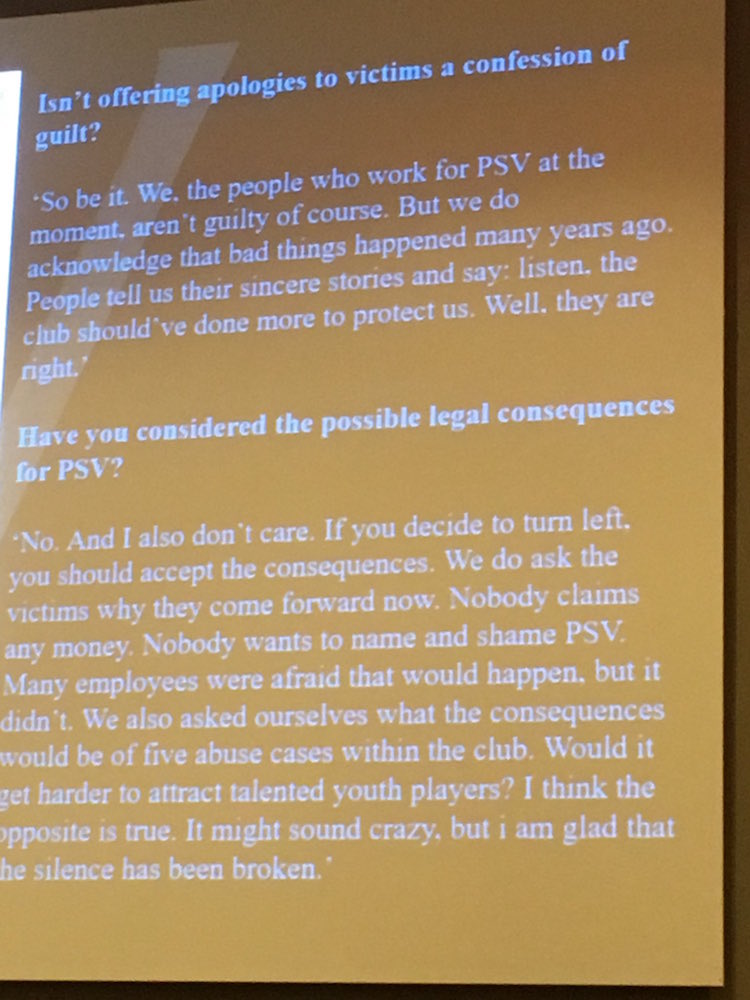 Delegates also heard a case study from PSV Eindhoven, whose Chairman has offered an unreserved apology to the victims of sexual abuse at the club’s youth academy in the 1970s and 80s. William Feenstra of Voksrant explained how his newspaper had launched an investigation after reading about Operation Hydrant, sparked by Andy Woodward’s decision to come forward regarding sexual abuse in UK football. Worryingly, he explained that the main perpetrator has changed his name, is living overseas and is still training youth footballers.
Laura Robinson, a former cyclist and skier and now journalist who wrote about ‘Sport’s Dirty Little Secret’ for the Toronto Star newspaper in 1992, explained that the issue is a huge problem. “The doping was nothing compared to the sexual abuse”, she said.
Speakers were sceptical of the idea that a new regulator or regulations would serve to better protect athletes, stating that engaging with the victims is key, which is why Rolf’s Voice Project is crucial. “Sport doesn’t need policies that are put on shelves”, highlighted Leach. “Victims are still being excluded from programmes designed to formulate such policies. You can’t educate about this issue unless you have been involved. Communication, education and awareness are key”.
• Eleven athletes (and a horse trainer) from eleven countries, competing in nine sports, were...
• 20 athletes from nine countries, competing in ten sports, were involved in anti-doping proceedings...
• Twenty four athletes from 13 countries, competing in eight sports, were involved in anti-doping...