

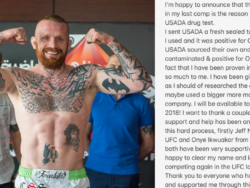
The trouble with Ostarine: Jimmy Wallhead’s
16th March 2018
Features


The protection of clean athletes and the fight against doping are top priorities for the International Olympic Committee (IOC), as outlined in Olympic Agenda 2020, the IOC’s strategic roadmap for the future of the Olympic Movement. To provide a level playing field for all clean athletes at the Olympic Games Rio 2016, the IOC put special measures in place, including targeted pre-tests and the re-analysis of stored samples from the Olympic Games Beijing 2008 and London 2012, following an intelligence-gathering process that started in August 2015.
As part of this process, the IOC today announced that one athlete has been disqualified from the Olympic Games Beijing 2008. The details follow.
Tatiana Chernova, 29, of Russia, competing in the women’s heptathlon event in which she ranked 3rd and for which he was awarded a bronze medal, has been disqualified from the Olympic Games Beijing 2008. Re-analysis of Chernova’s samples from Beijing 2008 resulted in a positive test for the prohibited substance dehydrochloromethyltestosterone (turinabol).
The IOC Disciplinary Commission, composed for this case of Mr Denis Oswald (Chairman), Mr Juan Antonio Samaranch and Dr Ugur Erdener, decided the following:
The full decision is available here.
In order to support the investigations of Prof. McLaren and his team, the IOC ordered a number of targeted re-analyses of Russian athletes’ samples during the course of 2016.
As part of this process, the IOC today announced that one Russian athlete has been disqualified from the Olympic Games London 2012. The details follow.
Maksim Dyldin, 29, of Russia, competing in the men’s 400m event (round 1 and semi-final) in which he ranked 17th, and in the men’s 4x400m relay event (round 1 and final) in which he and his teammates ranked 5th and for which they were awarded a diploma, has been disqualified from the Olympic Games London 2012. Re-analysis of Dyldin’s samples from London 2012 resulted in a positive test for the prohibited substance dehydrochlormethyltestosterone (turinabol).
The IOC Disciplinary Commission, composed for this case of Mr Denis Oswald (Chairman), Mrs Gunilla Lindberg and Dr Ugur Erdener, decided the following:
The full decision is available here.
The additional analyses on samples collected during the Olympic Games Beijing 2008 and London 2012 were performed with improved analytical methods, in order to possibly detect prohibited substances that could not be identified by the analysis performed at the time of these editions of the Olympic Games. For further details, please consult the following factsheet.
• This media release was originally published by the International Olympic Committee (IOC) on 24 April 2017. To access the original, please click here.
• Eleven athletes (and a horse trainer) from eleven countries, competing in nine sports, were...
• 20 athletes from nine countries, competing in ten sports, were involved in anti-doping proceedings...
• Twenty four athletes from 13 countries, competing in eight sports, were involved in anti-doping...