






The trouble with Ostarine: Jimmy Wallhead’s
16th March 2018
Features



Italian mountain bike champion Elena Gaddoni has escaped with a five month ban for a second doping offence, which followed an 18 month ban issued in 2010. Gaddoni was provisionally suspended on 15 February for an adverse analytical finding (AAF) involving acetazolamide, a diuretic. On 8 June, Italy’s national anti-doping agency (NADO Italia) announced that she had been sanctioned with a five month ban, ending 9 August 2021. The statement reveals that Gaddoni was able to demonstrate that the ADRV was not intentional and that she bore no significant fault, allowing her to reduce her sanction.
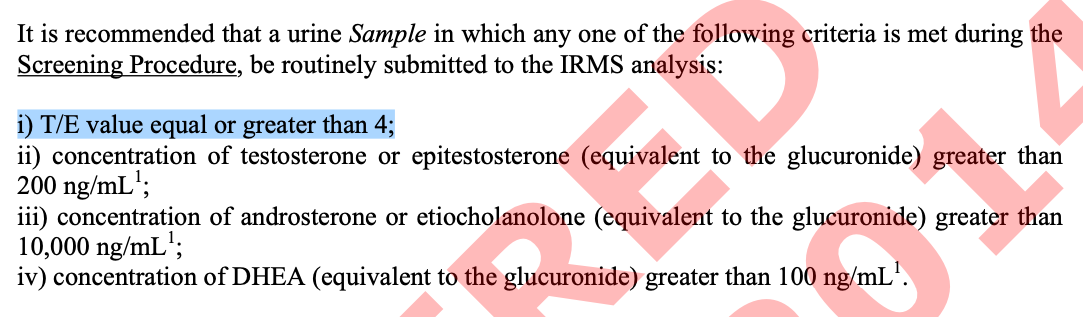
The five month ban represents Gaddoni’s second ADRV. In 2010 she was sanctioned with an 18 month ban by the Italian Olympic committee (CONI), after a sample taken on 24 April showed a testosterone to epitestosterone ratio of 4:1. Under the WADA Technical Document in force at the time, this was the threshold required to indicate use of exogenous (external) testosterone.

On 26 May, NADO Italia postponed a national anti-doping tribunal hearing (TNA) into Gaddoni’s case until 4 June. This was five days after the Executive Committee of the World Anti-Doping Agency (WADA) approved new guidelines regarding six diuretics, one of which (acetazolamide) was involved in Gaddoni’s AAF.
The new guidelines concern six diuretics that are commonly found as contaminants in pharmaceutical products, and outline that levels below 20ng/mL should not be considered as an AAF, or ‘positive test’. The levels of the diuretic in Gaddoni’s sample were not announced but they were presumably higher than 20ng/mL. If they were lower, Gaddoni couldn’t have ‘tested positive’ and couldn’t have been sanctioned with an anti-doping rule violation (ADRV).
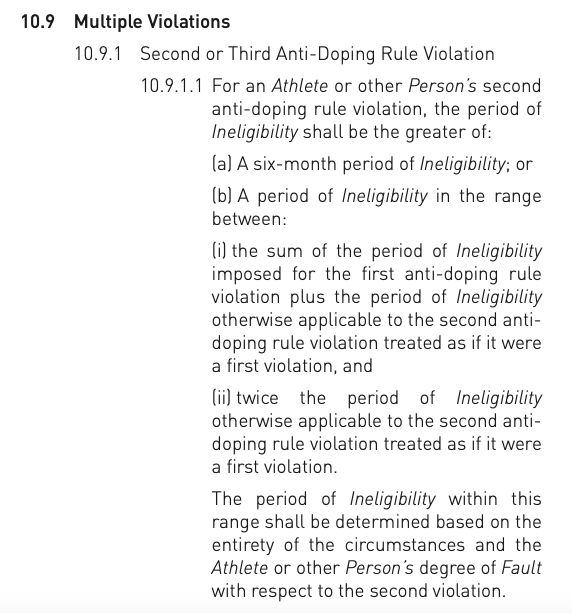
The World Anti-Doping Code outlines that second ADRVs should be sanctioned with a minimum six month period of ineligibility, but adds that this can be reduced under Article 10.7. This allows reductions in bans where ‘substantial assistance’ provided by the athlete enables the discovery of other ADRVs. As Gaddoni’s ADRV was judged to be non-intentional, it appears unlikely that Article 10.7 would be applicable.
• Eleven athletes (and a horse trainer) from eleven countries, competing in nine sports, were...
• 20 athletes from nine countries, competing in ten sports, were involved in anti-doping proceedings...
• Twenty four athletes from 13 countries, competing in eight sports, were involved in anti-doping...