





The trouble with Ostarine: Jimmy Wallhead’s
16th March 2018
Features



Aslı Çakır Alptekin is assessing what legal avenues are open to her after agreeing a settlement she labelled as ‘unfair’ with the International Association of Athletics Federations (IAAF), which reduced the life ban it sought to eight years. Alptekin maintains that the abnormal blood values identified through analysis of her athlete biological passport (ABP) were caused by factors other than blood doping and in any case, did not relate to the period in which she won the 1,500m at the London 2012 Olympics.
‘I want to stress that the date of the athlete biological passport blood values held against me are not related to the London 2012 Olympics period’, said Alptekin (pictured) in a statement posted on Facebook. ‘The sample I gave at the Olympics, and before that, did not detect a banned substance. I still continue with my training and will make the maximum effort to ensure our continued success in our legal fight to return to represent my country on the track as soon as possible.’
What form such a legal challenge could take is not yet clear. Last week, the Court of Arbitration for Sport (CAS) approved an agreement to settle signed by Alptekin, the IAAF and the Turkish Athletic Federation (TAF), which in December 2013 overturned her provisional suspension due to lack of evidence. ‘Any and all other claims for relief that any party might otherwise have made against another in relation to the subject-matter of these proceedings are released and discharged unconditionally, and they may not be pursued in any form hereafter,’ read the CAS Consent Arbitral Award.
‘The IAAF recently started to use the biological passport programme to accuse athletes based on the rise and fall of historical blood values, which even if a banned substance was not detected gives rise to doping penalties if the athlete cannot explain the blood values’, read the statement. ‘I’m faced with these accusations with no opportunity to give an explanation for the blood values […] This is not about my blood values at the 2012 Olympic Games, as public opinion has suggested, but is about my blood values before this date in 2010. Therefore, any accusation that I doped at the London 2012 Olympic Games is groundless.’
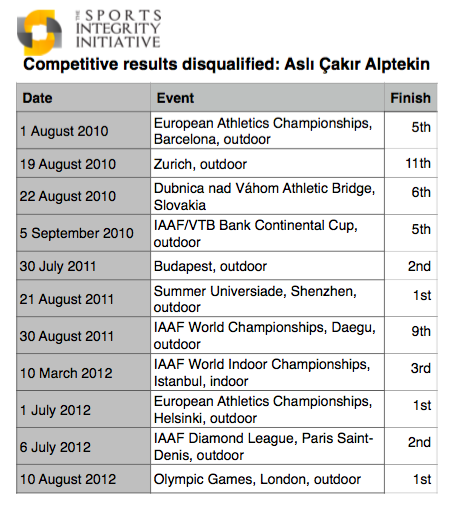
Click table to open in new tab…
In the case before the CAS prior to the settlement agreement, the IAAF had argued that Alptekin had used an ‘erythropoiesis-simulating agent or a prohibited method (blood transfusion) starting prior to the 2010 European Championships and continuing through to mid-2012’. Alptekin had argued that the suspicious values were caused by a combination of living and training at altitude, use of altitude-simulating techniques (such as oxygen tents) and medical issues. She also argued that the IAAF had not proved the allegations that it made to the requisite standard.
Click table to open in new tab…
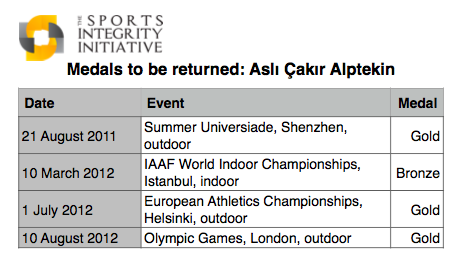
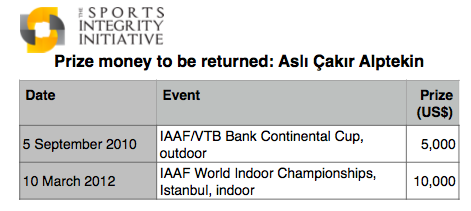
Alptekin accepted that the blood values were abnormal, but in the words of the CAS, she was ‘unable to substantiate the explanations she has offered for those values, and therefore is unable to rebut the IAAF’s assertion that those values are the result of some form of blood manipulation’. As such, she faced an eight-year ban for a second doping offence, having already served a two-year ban after testing positive for anabolic steroids in 2004 at the IAAF World Junior Championships in Gresetto, Italy. Her results, prizes and medals are also cancelled, as our tables illustrate. Turkish rival Gamze Bulut, who finished second at London 2012, is in line to receive Alptekin’s gold.
Click table to open in new tab…
• Eleven athletes (and a horse trainer) from eleven countries, competing in nine sports, were...
• 20 athletes from nine countries, competing in ten sports, were involved in anti-doping proceedings...
• Twenty four athletes from 13 countries, competing in eight sports, were involved in anti-doping...