


The trouble with Ostarine: Jimmy Wallhead’s
16th March 2018
Features

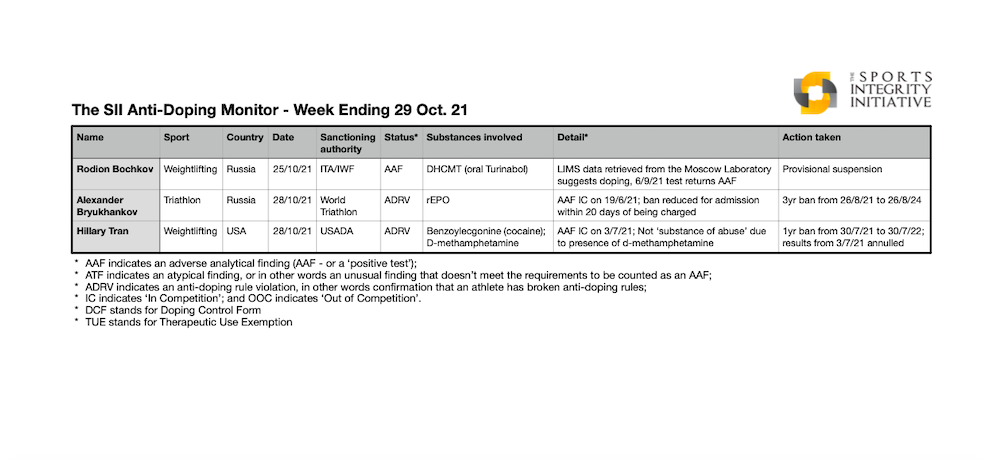
Just three athletes from two countries, competing in two sports were involved in anti-doping proceedings this week, which was the quietest since we launched the Anti-Doping Monitor. However, the circumstances behind all three cases are interesting.
The International Testing Agency (ITA) investigated a 2012 sample provided by weightlifter Rodion Bochkov (Родион Бочков) based on data received from the Moscow Laboratory Information Management System (LIMS) by the World Anti-Doping Agency (WADA). The ITA charged him with use or attempted use of a prohibited substance based on this data, but also decided to conduct an out of competition test on 6 September 2021. This returned an adverse analytical finding (AAF – or ‘positive test’) for DHCMT, otherwise known as oral Turinabol.
It is important to clarify that Bochkov hasn’t yet been convicted of an ADRV. However his case raises an interesting question. Given the nine year gap between Bochkov’s 2012 sample and his 2021 sample, it is perhaps also prudent to reanalyse all of his past samples. It will be interesting to see if this has been done when the ITA and International Weightlifting Federation (IWF) hold a full hearing into his case.
Alexander Bryukhankov (Александр Брюханков) is one of the most successful triathletes in the Russian national team. He returned an AAF for erythropoietin (EPO) at the European championships in June. Three months passed, during which Bryukhankov didn’t request the analysis of his B sample. After the deadline for B sample analysis expired, World Triathlon charged him with an ADRV in September. Because he now chose to admit the ADRV within 20 days of being charged, he received a one year reduction in his ban, which will end on 26 August 2024.
Such ban reductions are made possible by Article 10.8.1, a new addition to the 2021 World Anti-Doping Code. The intention is to save anti-doping organisations (ADOs) and athletes the time and cost of holding a hearing. However, it is increasingly becoming clear that there are issues with this approach.
Firstly, it potentially allows athletes who were caught doping in an Olympic final to compete in the next Olympics, if they admit doping. An innocent athlete faces the cost and stress of a hearing during which they must overcome the high hurdle of proving that they are innocent, otherwise they will face a four year ban, which would mean missing the next Olympics. It is easy to see how innocent, young athletes that lack financial resources might be pressured into admitting to something they didn’t do.
As a long standing member of the Russian national team, Bryukhankov doesn’t fall into this category. He has admitted his ADRV, so no hearing will be held. This is potentially problematic, as three Russian national team members have recently returned AAFs for EPO. A hearing was also avoided in the Igor Polyanski case, as he admitted his ADRV within 20 days of being charged.
Both Bryukhankov and Polyanski were coached by Nicolas Romanov until 2016, although there is no suggestion that he is involved as he is no longer listed as a trainer certified by the Russian triathlon federation (ФТР). All coaching staff listed on the ФTP internet site were certified after 2017. It is not clear who coaches Bryukhankov and Polyanski at present.
On the face of it, this means that the ФТР has avoided an external investigation into why two national team members reported AAFs for EPO. Those responsible for supplying EPO to the two athletes can carry on supplying it.
The ФТР has promised to investigate, and it is possible that World Triathlon may be investigating. Under Article 20.1.9 of the World Anti-Doping Code, signatories agree to ‘vigorously pursue all potential anti-doping rule violations within its authority including investigation into whether Athlete Support Personnel or other Persons may have been involved in each case of doping’.
However, because of the policy that most ADOs operate, which is not to comment unless there is a case to answer, we may never find out how – or if – an investigation was carried out. It would appear that an unintended consequence of this change to the 2021 Code was to make it easier for sporting bodies to avoid investigating doping.
The final case illustrates how the ‘Substances of Abuse’ clause, introduced under the 2021 Code, can fall down when street drugs are involved. Hillary Tran established that she used cocaine outside of competition in a context unrelated to sporting performance. However, her positive test also involved methamphetamine.
‘USADA concluded that a reduction to the otherwise applicable two-year period of ineligibility for d-methamphetamine was appropriate because an extensive investigation found sufficient evidence that Tran was exposed to d-methamphetamine through a contaminated street drug’, reads a statement (see below). Because metthamphetamine isn’t covered by the ‘Substances of Abuse’ clause, she was sanctioned with a one year ban.
The power that criminalisation of the supply of doping products used to cheat in sport holds was illustrated by two bans issued to Italians this week. Maurizio Intranova and Emanuele Ferrari, both of whom are unaffiliated to a sporting body, were both sanctioned with ten year bans. As such, sporting federations have been made aware of people that had the potential to supply athletes with prohibited substances. Contrast this with the approach to the supply of EPO to members of the Russian triathlon team…
Please continue to send any suggestions through to our editor by clicking here. Also, if you’re an athlete, national anti-doping organisation (NADO) or other Results Management Authority and you’d like us to cover a case that you’re involved with, please get in touch!
• Eleven athletes (and a horse trainer) from eleven countries, competing in nine sports, were...
• 20 athletes from nine countries, competing in ten sports, were involved in anti-doping proceedings...
• Twenty four athletes from 13 countries, competing in eight sports, were involved in anti-doping...