
The trouble with Ostarine: Jimmy Wallhead’s
16th March 2018
Features


A record 19 national anti-doping projects have applied for over €600,000 from the UNESCO Fund for the Elimination of Doping in Sport, which held a Committee meeting in Moscow yesterday. At the meeting, it was also agreed to provide over €300,000 in funding to anti-doping projects in Bhutan, Greece, Cape Verde, Malawi, Mongolia, Panama, Romania, Saint Martin, Trinidad & Tobago, and Ukraine.
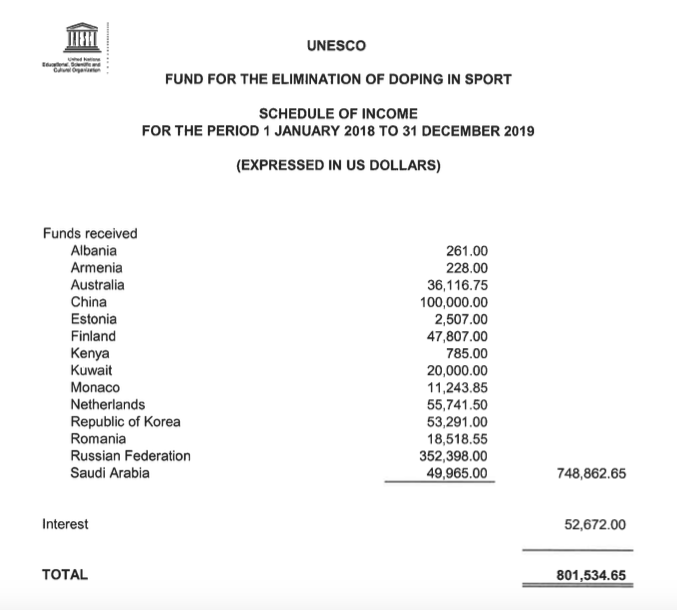
Three meetings of the Committee in charge of administering the fund are normally held in Paris annually. Russia, which in 2018/19 was by far the main contributor to the Fund (see right), offered to host yesterday’s meeting due to the difficulties caused by Covid-19. The previous meeting was held in Dubai.
Since the Fund was established in 2008, over 200 projects from 108 countries ave received funding totalling US$4.5 million. Kirill Kozhevnikov (Кирилл Кожевников), Deputy Director of the Legal Department of Russia’s Ministry of Sport is a member of the six person Committee in charge of the Fund.
Oleg Matytsin (Олег Матыцин), Russia’s Minister of Sport, is one of four Deputy Chairs of UNESCO’s International Convention Against Doping in Sport, which has been ratified by 191 States. “In a pandemic, the importance of the Fund’s work is growing as never before, because the Fund’s readiness to help and support countries during this difficult period comes to the fore”, he said in a statement. “The uniqueness of the Foundation lies in the fact that some States help others to improve national practices in the field of combating doping in sport without politicisation and outside interference. Our task is to implement systematic work, build a constructive and long-term dialogue with the entire international community: WADA, the UNESCO Committee, the Foundation and international federations.
“The fact that Russia has recently been demonstrating openness, constructiveness and adherence to the principles of fair play is understandable to everyone. We see this through the confidence that international federations have in Russia for the implementation of major international projects.
“It is important for us to create a culture of intolerance to doping and to demonstrate the openness of Russia as a reliable partner of world sport. The mission of the Foundation is to help strengthen the anti-doping system. In the Russian Federation – in recent years – this system has been one of the most efficient in the world. We interact with WADA through RUSADA. A very effective mechanism of work in the regions and sporting federations has been created.
“We see changes – a culture of zero tolerance for doping is taking shape. Our main task is prevention, implementation of educational programmes – starting with children and youth sports and continuing with the sports reserve and national teams.”
In January, the Court of Arbitration for Sport (CAS) banned Russian politicians from attending major sporting events and banned Russia from bidding to host major sporting events. The host of the 2032 Olympics is due to be announced between 2021 and 2025. Russia’s bid was initially rejected by the International Olympic Committee (IOC) in late 2019 due to WADA’s four year prohibition on Russia bidding to host the Olympics or World Championships.

WADA initially stipulated that ‘Russia may not bid for the right to host the 2032 Olympic Games and Paralympic Games, irrespective of whether the bidding for that right takes place during or after the Four Year Period’ (see right). The CAS ruling doesn’t mention that clause at all. It would appear that the IOC could now appoint Russia as host of the 2032 Olympics in 2022, should it choose to.
• Eleven athletes (and a horse trainer) from eleven countries, competing in nine sports, were...
• 20 athletes from nine countries, competing in ten sports, were involved in anti-doping proceedings...
• Twenty four athletes from 13 countries, competing in eight sports, were involved in anti-doping...