
The trouble with Ostarine: Jimmy Wallhead’s
16th March 2018
Features


Athletics coach Andrei Valerievich Eremenko (Андрея Еременко) has been sanctioned with a four year ban for attempting to bribe a Doping Control Officer (DCO). The Court of Arbitration for Sport (CAS) upheld an appeal from the Russian Anti-Doping Agency (RUSADA) against a 12 April 2018 decision of RUSADA’s Disciplinary Anti-Doping Commission (DADC) not to sanction Eremenko.
That same DADC Decision involved a four year sanction issued to Yulia Viktorovna Malueva (Юлия Малуева) for ‘evading, refusing or failing to submit to sample collection’ during a 2 September 2017 test attempt at the Russian Track and Field Championships in Adler, Sochi. Malueva was part of the 4x100m St. Petersburg team that won a Silver medal at the Championships, and is coached by Eremenko. She has not appealed her sanction.
The 12 April 2018 DADC Decision found that there was insufficient evidence to sanction Eremenko for attempting to bribe the DCO. The sole CAS Arbitrator disagreed, concluding (PDF below) there is ‘no reasonable doubt’ that Eremenko made an attempt to bribe the DCO. That conclusion is based upon an assessment of the credibility of those giving evidence at a 3 December 2019 hearing.
Malueva’s sanction was based on RUSADA’s allegation that she feigned illness in order to avoid the 2 September 2017 test. It was alleged that when a DCO, Olga Meshkova, accompanied her to the toilet to deliver her urine sample, Malueva ‘fainted’ and dropped the urine sample into the toilet.
In her evidence to the CAS, Malueva claims that she consulted with Eremenko about feeling unwell prior to the 4x100m, but decided that she should compete to avoid letting the team down. Interestingly, she claimed that her sample had already been split into A and B samples when she ‘fainted’, arguing that the idea she was feigning illness to avoid doping control was ‘an assumption of RUSADA’. The CAS Decision doesn’t mention what happened to the B sample.
The CAS decision outlines that after Malueva ‘fainted’, she phoned Eremenko who called an ambulance. Meshkova and Eremenko accompanied Malueva to hospital in the ambulance. Lead DCO Igor Nitkin and DCO Georgiy Mareichev followed the ambulance by car.
Although the CAS Decision mentions that a doctor reported ‘normal stool and urine output’ for Malueva, she was apparently later diagnosed with acute respiratory infection and acute pharyngotracheitis, according to Eremenko. This diagnosis is not mentioned elsewhere in the Decision.
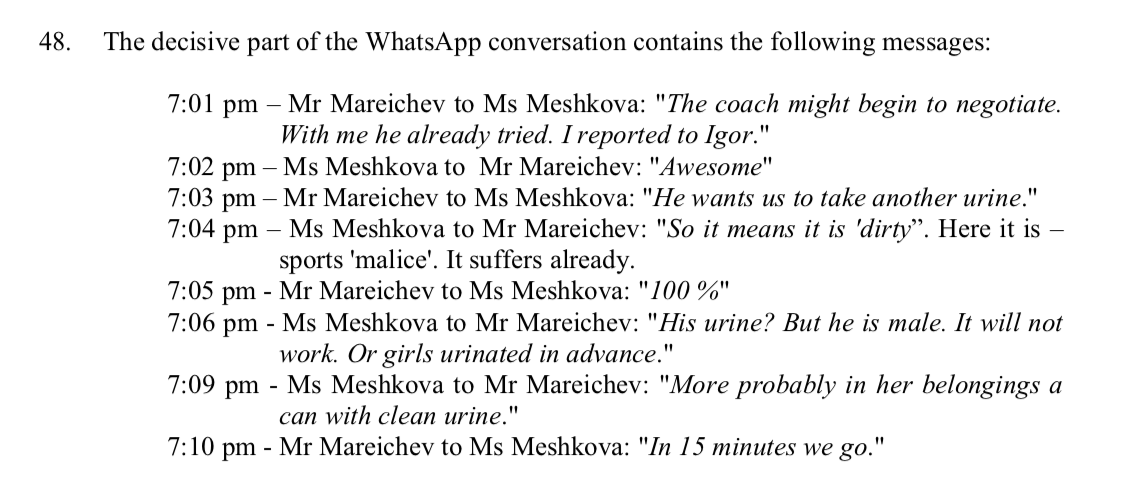
Based on the reports of DCO Mareichev, RUSADA alleged that Eremenko had offered Mareichev money if he would accept a ‘clean’ urine sample instead of one taken from the athlete. A WhatsApp conversation between Mareichev and Meshkova was produced as evidence (see right).
Eremenko denied having any conversation with Mareichev. But Ieva Lukosiute-Stanikuniene, the former Director of the Lithuanian anti-doping agency and one of two international experts appointed to coordinate doping control in Russia whilst RUSADA was suspended, confirmed that she had received reports of the attempted bribe from the report of another DCO, Anastasia Vadimovna Barabanshchikova, on 2 September 2017.
Barabanshchikova confirmed the accuracy of her DCO report and denied allegations that it had been written by somebody else. The CAS Arbitrator also did not accept the suggestion that the consecutive numbering of the DCO Reports suggested corruption, stating that this was often usual practice for a testing mission. The cited WhatsApp messages were also found to be authentic.
‘The other witnesses called by the Appellant convinced the Sole Arbitrator that there is no reason whatsoever to allege they have invented all this to cover up a mistake, protect themselves, or receive any bonus by creating untrustworthy evidence against the Respondent’, concludes the CAS Decision. ‘To devise such a story with all the different details as presented by the witnesses would take great creativity, a sophisticated coordination regarding timing as well as content and skills like actors that can hardly be imagined. This allegation by the Respondent is therefore rejected […] Finally, the Sole Arbitrator notes that the Respondent not even claims to have tried to convince the Athlete that she should do her outmost to provide a sample. After having been her coach for around 12 years, starting at a very young age, it was his duty to support her in the anti-doping procedure. Instead he let her take the risk to be sanctioned. This omission demonstrates that one cannot believe at all the Respondent’s final words that doping is unacceptable for him.’
• Eleven athletes (and a horse trainer) from eleven countries, competing in nine sports, were...
• 20 athletes from nine countries, competing in ten sports, were involved in anti-doping proceedings...
• Twenty four athletes from 13 countries, competing in eight sports, were involved in anti-doping...