

The trouble with Ostarine: Jimmy Wallhead’s
16th March 2018
Features



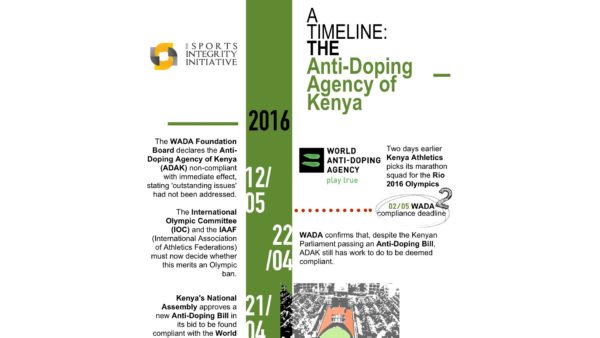
Kenya is hoping to establish a satellite blood testing laboratory, which it hopes will eliminate the need to send blood samples to Qatar for analysis. Anti-Doping Kenya said that the government’s Ministry of Sports, Culture and the Arts (MoSCA) had established a Committee on Anti-Doping Laboratory Development on 2 June last year, and has appointed Sarah Shibutse as ADAK’s representative on the Committee.
Shibutse said that the Committee is searching for a suitable institution to host the laboratory for the next three years, and seven hospitals have been identified as potential partners. It is understood that the satellite laboratory will work ‘under close supervision’ of the Lausanne Laboratory, which is accredited by the World Anti-Doping Agency (WADA).
Africa has not had a WADA-accredited laboratory for over a year, which means that anti-doping organisations (ADOs) such as ADAK have had to send samples to Doha for analysis. On 30 June 2017, WADA extended the suspension of the Bloemfontein Laboratory, which was initially suspended on 3 May 2016. The situation was compounded on 14 November 2016, when WADA suspended the Doha Laboratory. Fortunately, WADA was able to reinstate the Doha Laboratory in April last year.
• Eleven athletes (and a horse trainer) from eleven countries, competing in nine sports, were...
• 20 athletes from nine countries, competing in ten sports, were involved in anti-doping proceedings...
• Twenty four athletes from 13 countries, competing in eight sports, were involved in anti-doping...