





The trouble with Ostarine: Jimmy Wallhead’s
16th March 2018
Features

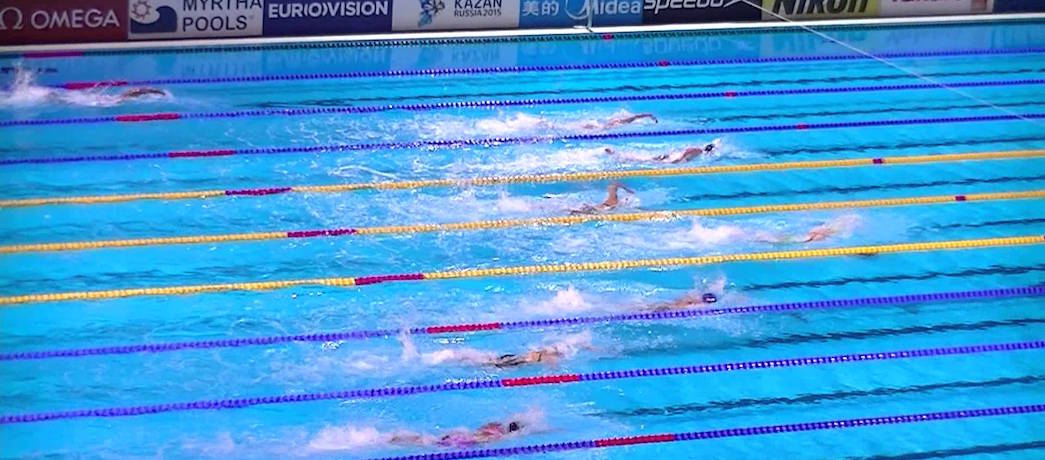
Two bans recently recently issued to swimmers appear to highlight a fundamental flaw in the anti-doping system – that athletes who commit an anti-doping rule violation (ADRV) can be sanctioned with the same ban, irrespective of the substance they test positive for. At first glance, it appears unfair to sanction athletes who have tested positive for testosterone and cannabis with the same four-year ban. Testosterone use, without a therapeutic use exemption (TUE), usually indicates an intent to enhance sporting performance. Cannabis is usually taken for recreational purposes not connected to sporting performance.
On 8 July, the Fédération Internationale de Natation (FINA) issued a four-year ban to Vitalina Simonova, a Russian breaststroke specialist after she tested positive for testosterone on 29 June 2015. On 11 July, FINA confirmed that a four-year ban had been issued to Iranian water polo player Hesam 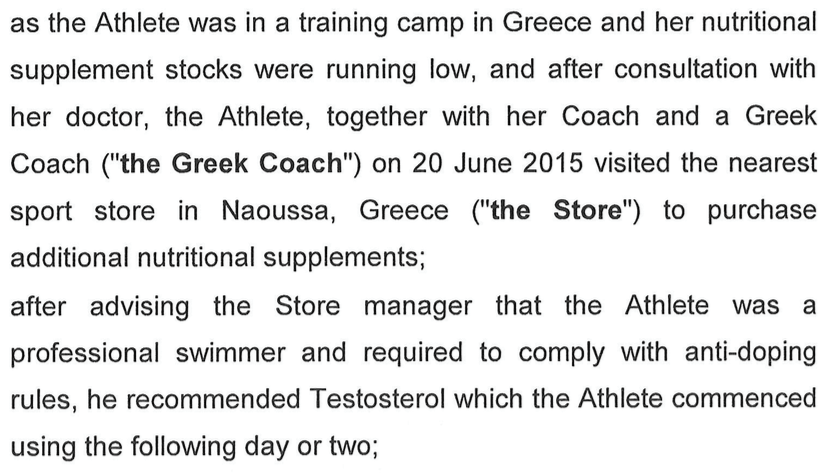 Jafari by the Iranian National Anti-Doping Organisation (NADO), after he tested positive for cannabinoids on 12 February 2016.
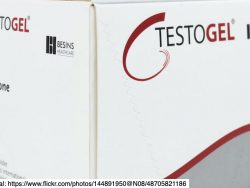
Analysis of the full FINA panel decision (PDF below) shows that while she admitted committing an anti-doping rule violation (ADRV), Simonova contended that she did not intend to enhance her sporting performance. She argues that she purchased Testosterol at a Greek store whilst training for the Swimming World Cup and on the advice of two coaches who had consulted with the store manager, she began using Testosterol with no intent to enhance her performance.
The FINA Doping Panel did not accept Simonova’s contention that she did not knowingly engage in conduct which could lead to an ADRV. It found that she ‘should have been alert to the similarity in the name Testosterol and the prohibited 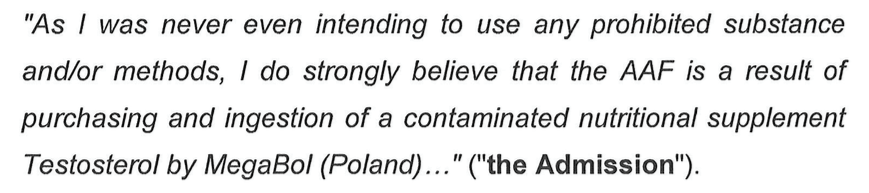 substance testosterone’, coming to the conclusion ‘the athlete was careless and intentionally took the risk of ingesting a product which contained the prohibited substance’. It also added that it was ‘hard pressed to follow the argument of the athlete, especially in light of the fact that the product name contains an indication of containing an anabolic agent’.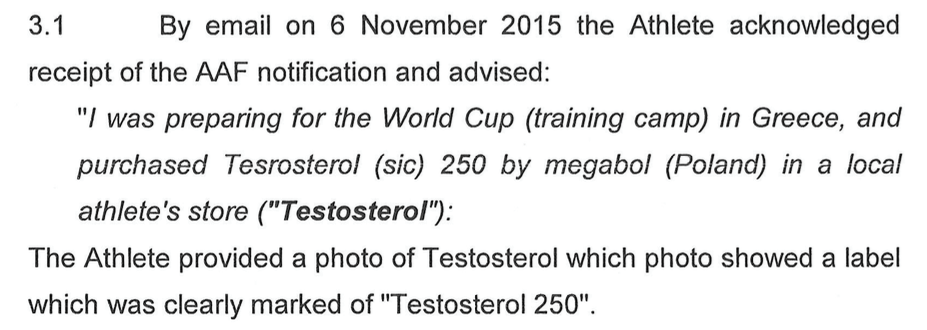
In other words, the panel didn’t accept that Simonova had proved that she didn’t intend to ingest the substance, hence the four-year ban. In other words, she knowingly ingested a substance that she was aware may cause an ADRV. The decision is perhaps unsurprising, given that the first result from a Google search for Testosterol directs to a site entitled ‘testosterone boosters’.
As we don’t have a copy of the decision issued by the Iran NADO to Jafari, we do not know whether he argued that his use was intentional or not. However, as a four-year ban was issued, we can assume that the panel was, at the least, not satisfied that he had established that his use was not intentional.
The decision once again raises the question of whether the World Anti-Doping Code should take a different approach to ‘recreational’ substances. The topic was considered during the drafting of the 2015 Code. Clause 10.4.3 allowed athletes to reduce their ban for a first violation to ‘at a minimum, a reprimand, and at a maximum, one (1) year Ineligibility’. It was removed from Version 2.0 of the Code in November 2012, a year before the final draft was approved on 15 November at the 2013 World Conference on Doping in Sport in Johannesburg.
“Clause 10.4.3 was not accepted by all stakeholders for various reasons”, a WADA spokesperson told World Sports Law Report at the time. “Some believed there should not be special treatment for cocaine and cannabis; some believed that substances of abuse would apply to a long list of substances including amphetamines and other drugs, and therefore it would be inappropriate; some stakeholders felt that rehabilitation would only be available in some parts of the world and, furthermore, that this provision would in fact be abused to reduce the sanction, with nothing to replace such a sanction.”
A comment in the Code’s Appendix 1 – Definitions now reads: ‘For Cannabinoids, an Athlete may establish No Significant Fault or Negligence by clearly demonstrating that the context of the Use was unrelated to sport performance’. This would allow Jafari to at least cut his sanction in half under Article 10.6 of the Code, just by arguing that he did not take cannabis in a sporting context. There are few instances where one might take cannabis in a sporting context, and water polo is not understood to be one of them.
Given this, the sanction issued to Jafari does appear harsh, especially when you consider the approach of other NADOs to athletes that have returned an adverse analytical finding (AAF) for the same substance (two months, six months, nine months, two months, and six months). However, these sanctions were all listed by countries which – it might be argued – have a different approach to sanctions for recreational drugs.
Given the sanction issued to Jafari, it would appear that he has not considered the potential for reduction offered by Appendix 1 of the 2015 Code, resulting in the standard four-year ban being applied by the Iranian NADO. He has now received the same ban as a swimmer which a panel has decided intentionally risked taking a product that she knew potentially contained a prohibited substance, and that does seem unfair. Perhaps the wording of this section is worth considering in the next round of the Code review process.
• Eleven athletes (and a horse trainer) from eleven countries, competing in nine sports, were...
• 20 athletes from nine countries, competing in ten sports, were involved in anti-doping proceedings...
• Twenty four athletes from 13 countries, competing in eight sports, were involved in anti-doping...